US Students 3D Print a Sustainable Lotus House for Solar Decathlon 2018
Students from Washington University in St. Louis have been working on an energy-efficient prototype ...

News and Insights of 3D Printing and Manufacturing
Homearchitecture
Students from Washington University in St. Louis have been working on an energy-efficient prototype ...
Chinese construction company HuaShang Tengda created this 3D printed villa in only 45 days – and the ...
IAAC, the Institute for Advanced Architecture, continues its research towards 3D printing architecture with local earthen materials by completing a housing prototype in the natural park of Collseolla, in the outskirts of Barcelona, this winter. The result is a small constructed prototype with 100% natural and locally sourced material recipes that will be inaugurated with a live event on February 28th [register here].
SAGA Space Architects, a Copenhagen-based design practice working on making space liveable for future space travelers, have 3D printed their new 7-meter-tall analog moon habitat – the world’s tallest 3D printed polymer structure. The shell has been topologically optimized, and the corrugated surface generated, to withstand the specific forces the habitat would experience on the Moon. The habitat was brought to life in just nine months – from the first sketch to the final printed form, and has been designed to support a crew of two astronauts, comfortably, for 90 days on the surface of the Moon.
Southeast Asia-based Siam Cement Group (SCG), one of the largest cement companies in the world, is now a distributor of COBOD 3D construction printers in Thailand and beyond. SCG previously used other printers to experiment with concrete 3D printing and produce various prototypes but the company has now turned to COBOD as means to increase large-scale production capabilities.
As 3dpbm had anticipated last month, COBOD has now, officially, launched the first 3D construction printer configurator – a new tool that enables contractors and developers to estimate the time it will take to 3D print a specific building and calculate the volume of concrete materials needed. For instance, the configurator shows, layer by layer, how the printer can build a 170 m2 (1.900 square feet) villa in just 26 hours.
A rural house in north China’s Hebei Province has been catapulted into fame recently for being the first 3D printed house in this rural area of China, built “scan by scan” with giant construction 3D printers.
Concrete 3D printing of building shells has grown considerably in the last few years, with more and more building shells being 3D printed, even buildings with up to 3 floors and windmill towers. However, the high cost of 3D printing mortars has prevented more widespread and large-scale application on multi-unit projects, including large-scale affordable housing projects. This is about to change as CEMEX, in cooperation 3D construction printer supplier COBOD, developed the new D.fab solution for rapid development of cost-effective concrete 3D printing materials.
Activities are set to intensify in 2022, as we get closer to the date (2024) that ESA and NASA have planned for humanity’s return to the Moon. The ESA Discovery program has been supporting groups from industry and academia to develop technologies for off-Earth manufacturing. Last November, a public online symposium presented their latest results and highlighted which technologies are most promising for maturing further towards integration into future space missions.
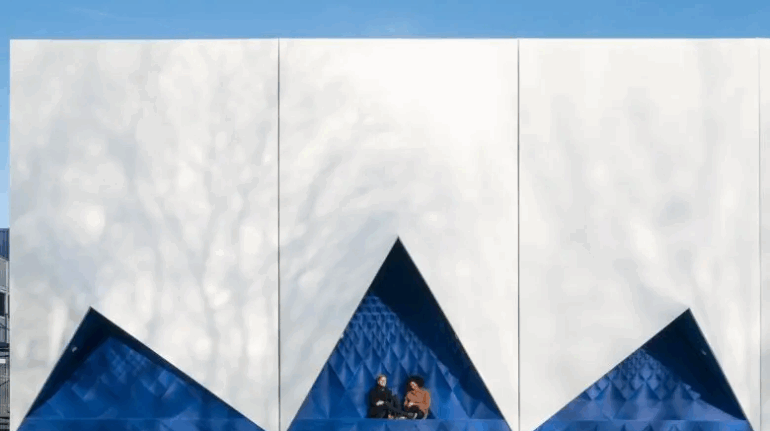
Bart Kellerhuis the creative director of Zecc Architecten is responsible for the temporary accommodation of the Dutch House of Representatives, more commonly known as ‘Tweede Kamer’. Zecc created a custom version of Aectual technology‘s Weave panels to design a unique circular canopy for the building.
Over three billion people are expected to need affordable housing by 2030. This issue is most acute in Africa, with countries like Kenya already facing an estimated shortage of two million houses. With 3D printing, constructions giant Holcim wants to be part of the solution via the joint venture 14Trees.
The integration of 3D printing processes into architecture is no longer a novelty. The advantages that additive manufacturing offers architects are also widely known. Complex geometries can be realized more easily, costs can be saved, and functionalities can be integrated directly into designs and construction plans. This integration of functions, however, can be taken even further. The Meristem Wall, a project at Lund University led by two Swedish innovative architects, David Andreen and Ana Goidea, who formed the bioDigital matter lab, uses voxeljet sand binder jetting technology to take the wall’s functionality to a new level, without compromising on aesthetics.
Vertico has signed a partnership agreement with MAI International to distribute its construction 3D printers along with a range of 3D concrete printing specific accessories Both companies have worked hard over the past years to innovate in the field of 3D concrete printing and have established highly complementary positions
What would Antoni Gaudí have created with the latest 3D printing technology? Would the unique, compl ...
Dutch technology provider CyBe Construction and Curaçao concrete expert Betonindustrie Brievengat (BIB) are joining forces for a strategic partnership. At the end of September, three operators of BIB will be trained by the team of CyBe to operate the purchased 3D printer. This is through a 10-day on-site training during which the first two buildings will be printed in the island of Curaçao, the first-ever 3D construction printing initiative in the Caribbean archipelago. These two buildings will serve as office space and café in Willemstad, the capital city of Curaçao.
The market for construction 3D printing continues to expand around the world and especially in Europe, where Swedish startup ConcretePrint (KonkretPrint AB) has unveiled the country’s first 3D printed home. The young company completed the inaugural structure in June 2021 at an industry plot in Tumba, Sweden. The project was undertaken with financial support from the Swedish Energy Agency.
It has been a busy month for Austin-based 3D printing construction firm ICON. Not only did it raise $207 million in Series B funding and unveil a 3,800-square-foot training barracks for the Texas Military Department, it has now brought four 3D printed homes to market in Austin, Texas, in collaboration with Kansas City developer 3Strands. Two of the four 3D printed homes have already been sold, while the remaining two are hitting the market today, August 31, 2021.
Dutch company Aectual, specialized in the creation of 3D printed architectural and interior desi ...
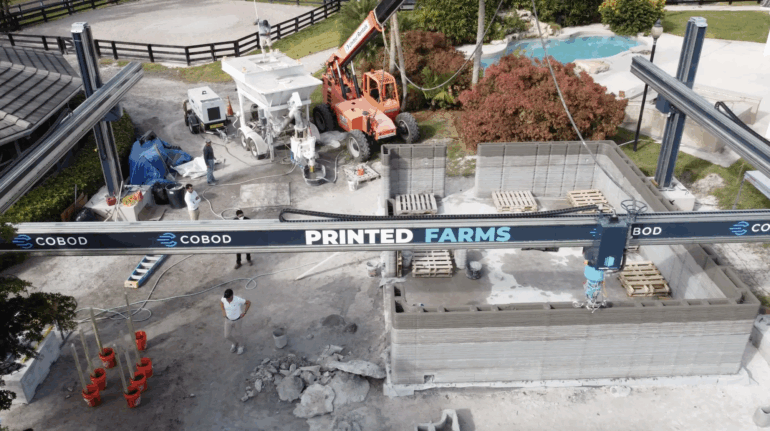
Danish construction 3D printer company COBOD, the current segment leader in Europe, recently entered the US market via a partnership with Printed Farms in Florida. The company is now expanding its footprint in the US to address the widespread lack of affordable housing in partnership with the non-profit organization Habitat for Humanity. In US market COBOD will be squaring off with current local leader ICON.
The Block Research Group at ETCH Zurich is working with Zaha Hadid Architects Computation and Design Group (ZHACODE), incremental3D and Holcim to build the Striatus 3D concrete printed masonry bridge, in time for the Venice Biennale exhibit.
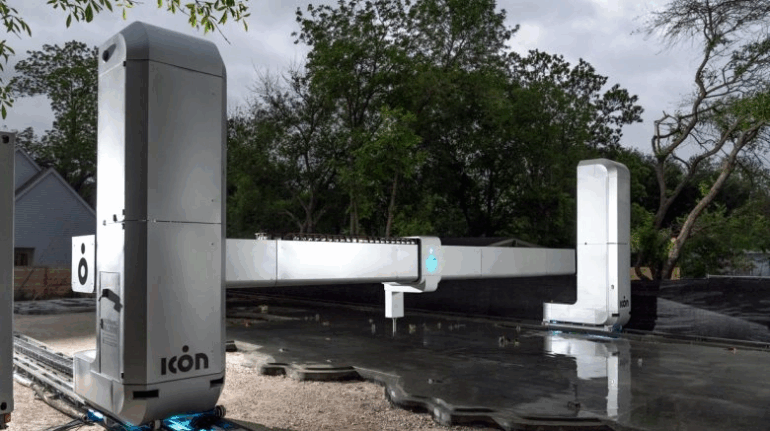
Texas-based construction 3D printing company ICON has once again upgraded its Vulcan system. The next-gen 3D printer was announced in parallel to a new 3D printed home initiative—the Exploration Series—which ICON is working on in collaboration with various world-class architects. We’ve got our first glimpse of the inaugural build of the series, House Zero, which is designed by Texas firm Lake|Flato Architects.
With 3D printing technology, you can alter your digital model, try out variations on the fly and vis ...
3D print applications have revolutionized industries from architecture, construction, furniture ...
Danish robot 3D construction printer company COBOD International A / S, which produces large 3D printers for robot printing of buildings and wind turbine towers in concrete, submitted the financial accounts for 2020, which show that COBOD fiscal 2020 results generated profits of 9.3 million DKK (about €125,000), being profitable for the second year in a row after growing almost 100% (from 4.9 million DKK, about €65,000).
Printed Farms is the first organization in the United States to get a Cobod Bod 2 Concrete 3D Printer. I got the chance to check out a job site of theirs near West Palm Beach, Florida. This project is a 30×30 agricultural building that will ultimately serve as storage for equipment that the owner has to manage their many horse stables.
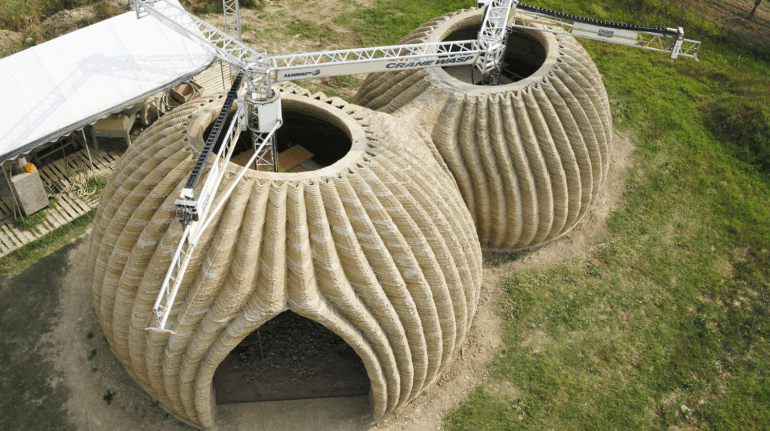
The Italian firm World’s Advanced Saving Project (WASP) has completed the printing phase of its TECLA supporting structure, a 3D printed house based on natural materials that is made with multiple 3D printers operating at the same time. The habitat model was engineered by WASP and designed by MC A, Mario Cucinella Architects. It took form as a new circular model of housing entirely created with reusable and recyclable materials, sourced from local soil, carbon-neutral and adaptable to any climate and context.
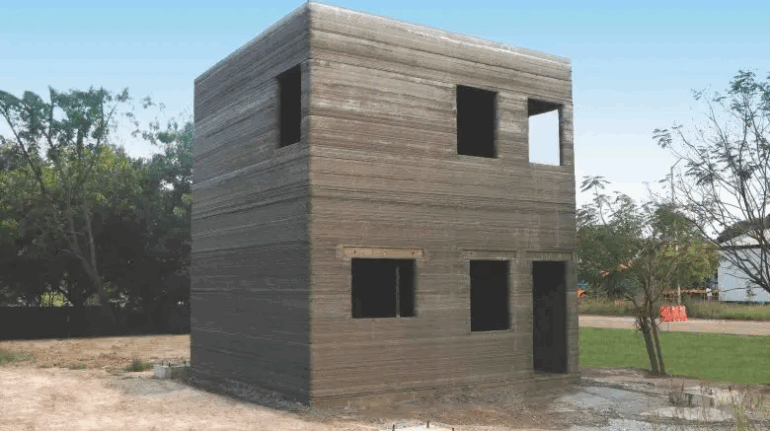
COBOD, a company that specializes in 3D printing buildings, printed a concrete two-story building in India made by L&T Construction, a first for the AM industry. COBOD’s expertise as a construction specialist is evidenced by its partnership with GE Additive, where COBOD prints bases for 200-meter-tall wind turbines. The company has also printed 3.5 houses in four days. Its efforts averaged eight square meters an hour on this occasion.
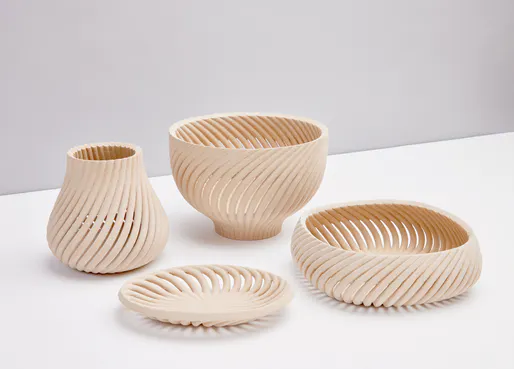
Since its founding in 2017, Dutch company Aectual has taken the tenets of 3D printing—including customization, design freedom and sustainability—to heart, applying them to the areas of architecture and interior design. Many of our readers will be familiar with the company: in 2018, it gained notice for 3D printing a section of terrazzo-style flooring in Amsterdam’s Schiphol Airport. Just a few months ago, it also unveiled a collection of 3D printed fully-circular furniture made from plant-based materials.
CERN’s newly proposed EIFFEL space elevator accelerator is eventually going to be the tallest structure on Earth. 3dpbm can exclusively reveal that the 2.5 Km tall structure will be entirely 3D printed using both concrete and metals, which engineers now see as the only possible way to make it structurally sound.
A new video published by 3dpbm’s contributor Jarett Gross explores the concept invented by an interesting Russian startup called Printed Dome. that developed a proprietary construction 3D printing approach to make—you guessed it—3D printed domes.
Dubai Municipality has won the UAE Ideas Award organized by the Dubai Quality Group under the slogan, ‘Nothing is Impossible,’ for the category of ‘Innovation in the field of inventions’ for constructing the World’s Largest 3D Printed Building. Sheikh Mohammed bin Rashid Al Maktoum, Vice President and Prime Minister of the UAE and Ruler of Dubai, had launched the Dubai 3D Printing Strategy as a unique global initiative.
LafargeHolcim and XtreeE have strengthened their strategic partnership, which dates back to 2016, to develop innovative solutions for sustainable construction. The story, reported by several credible French media sources, indicates that as a 20% shareholder in XtreeE, LafargeHolcim France becomes a director and thus joins the Co-founders of the company, Vinci Construction Invest and the investment fund Shibumi International.
Dutch company CyBe is known in the AM construction world for its robotic 3D printing platform and special MORTAR material. We’ve followed the company in recent years, as it has worked on construction 3D printing projects around the world, including in New Zealand, the United Arab Emirates and Italy. And while the company has been forthcoming about its ABB-based technology, the details of its MORTAR construction material have been fully under wraps. That is, until now.
World Housing and Twente Additive Manufacturing (TAM) collaborated with other companies in British Columbia, Canada, to construct a 3D-printed affordable community. The project will be located in Nelson, B.C., where there is a great need for housing and the support needed from the local community and government. It is also the hometown for TAM.
Black Buffalo 3D Corporation, a leading provider of large scale 3D printers for construction and a member of HN Inc.—formerly Hyundai BS&C Co. Ltd.—has successfully collaborated with the International Code Council Evaluation Service (ICC-ES) to revise its ICC-ES AC509 criteria. This update enhances the acceptance criteria (AC) for 3D Automated Construction Technology for 3D printed concrete walls from single-story building construction to multi-story building construction.
Mitch Lewandowsky, Branch Technology‘s Chief Commercial Officer, had been hinting at a major project for some time. It has now finally been revealed that it’s not just one project but at least two, and possibly more, and they are both massive in size: a 3D printed facade for the Tennessee Valley Federal Credit Union building and exterior wall panels for the Center of Engineering, Technology, Arts & Sciences at the Chattanooga State Community College.
Architect and professor Ronald Rael joined a movement championed by Alight that aims to bring radical hospitality to stretches of the U.S.-Mexico border. The move further extends Rael’s additive manufacturing profile into the humanitarian space. His architecture studio, Rael San Fratello, recently bridged the border using seesaws in a living art project called Teeter-Totter Wall.
MEET – Middle East Eng. Technologies – just finished the construction of the MEET 3D Villa in the UAE. The villa was printed in just 2 weeks in Sharjah, in the heart of SRTIP, with the help of the CyBe team’s expertise, providing on-site training and support.
The introduction of 3D printing – in any form – into the construction industry is among the most fascinating and, at the same time, challenging endeavor. On the one hand, the most advanced and technologically complex, digital manufacturing processes; on the other an industry that has notoriously been slow to introduce change. For these reasons, many see construction as the area with the highest potential for 3D printing innovation. And business. The shift is going to be gradual and any potential adopter will benefit from introducing 3D printing technologies that can significantly enhance traditional construction practices. Massivit 3D’s large-volume 3D printing technology for construction is doing just that. By providing cost-effective 3D printed tools to leverage the geometric benefits of AM, without foregoing the use of traditional materials, Massivit 3D is enabling innovative constructions and restorations. These projects – from statues to capitols and decorations of historical Italian palaces – would not have been cost-effective by either traditional construction methods or direct concrete 3D printing.
Combining one of the world’s most sustainable, available and strong materials with the inherently sustainable, tool-less construction 3D printing technologies could be a game-changer. However 3D printing hemp is difficult at best, as 3D printing pioneer Andry Rudenko – also a developer of both hempcrete material and construction 3D printing technologies – recently explained to 3dpbm. An Australian, Perth-based company, MIRRECO, said they are developing a CAST® hemp-based construction 3D printing process that will also be able to store CO2 removed from the atmosphere.
The Tainan branch of Taiwan Everplast Machinery Co., Ltd. cooperated with C-Hub of Cheng Kung University this year to research cement-based 3D printing technology. One of the results of the study is the development of a pellet cement-like material to use in extrusion 3D printing of furniture structures.
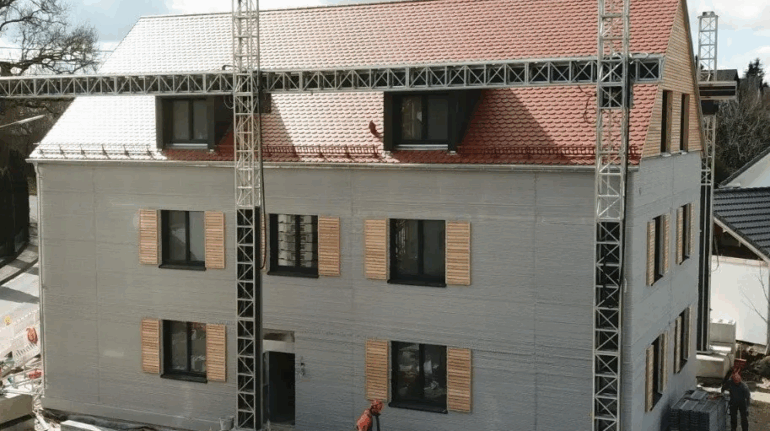
3D printed buildings are popping up in more and more places, like the recent 3 floors apartment building in Germany but so far Africa has been only marginally on the map. 14Trees are about to change that. Established by LafargeHolcim, a world-leading provider of cement and concrete with 70,000 employees, 14Trees is focused on building affordable houses, schools and social infrastructures in Africa.
A study published by researchers at Stellenbosch University in South Africa presented a first and comprehensive microstructural investigation of construction 3D concrete printing porosity using X-ray computed tomography to visualize and quantify porosity, pore sizes, shapes and distributions in extrusion-based 3D printed concrete.
Thanks to the latest video by Jarett Gross, the untirable explorer of construction 3D printing projects (who has previously contributed to this portal), many more, including 3dpbm, found out about a very interesting 3D printed, upcycled cement-wooden structure that may have been initially ignored by those outside the architectural community: the Ashen Cabin by Cornel University and HANNAH Design Office.
Helsinki Cathedral, Helsinki, Finland Italian engineer Angelo D’Angelo has two big obsessions: t ...
Hotel management group Habitas has raised US$20 million to expand its concept of "social" beach huts ...
Italian design firm Barberio Colella Architetti and architect Angelo Figliola proposed a project c ...
In the global pandemic, Christian Nunez, a second-year plant science student from West Covina, launc ...
Prvok (Protozoon) will be built in the Czech Republic this June. All images courtesy of Stavební sp ...
The goal of the collaboration between GE Renewable Energy, COBOD, and LafargeHolcim is to build a 20 ...
This Review for Cetus was written by Zepeng Zhou, a graduate student at Washington University in S ...
The pavilion is designed in the Great Northern Way, with florid wood, steel and glass structures ...
The US-based Pikus Concrete has partnered with Sika to commercialize 3D concrete printing technology ...
Researchers from France and the UK are looking for ways to improve the 3D printing of buildings, and ...
World's largest 3D-printed building completes in Dubai Last week, the world's largest 3D-printed bu ...