Materialise advances sustainable eyewear with 100% bio-based AM material Consumer Products

Materialise Advances Sustainable Eyewear with 100% Bio-based

 Materialise, a global leader in 3D printing solutions, paves the way toward a sustainable eyewear industry by expanding its range of materials to include Polyamide 11 (PA11). The 100% bio-based polymer is made from sustainably farmed castor beans and offers excellent properties for eyewear. By addressing overproduction, the fashion industry’s biggest environmental challenge, 3D printing helps brands meet the expectations of environmentally conscious eyewear consumers.

3D Coffee, the next coffee revolution enabled by 3D printing Consumer Products

3D Coffee, the Next Coffee Revolution Enabled by 3D Printing

3D Coffee is a project financed by the European Union funds as part of the First Open Call of the Digital Innovation Hub World, which sees the innovative startup Additive Appliances and the Kilometro Rosso innovation center as protagonists, with the additive technologies lab Lisa Tech. To prepare quality coffee, pressure and temperature control are essential. The “thermo-mechanical” or traditional machines, such as the Moka, the siphon, or the French press, do not directly control these variables and have well-known process limits; however, they are eco-friendly and have a greatly reduced environmental impact, more than 30%, compared to electric machines.

Pielleitalia and Roboze recycle textiles into 3D printing filament AM Industry

Pielleitalia and Roboze Recycle Textiles into 3D Printing Filament

Plastic, and its use/abuse in the global community, is among the most pressing issues of the last decade, where the high degree of competitiveness and performance of the material is opposed to the environmental and health issues. Interestingly, many plastics used in 3D printing are not used solely to make parts: advanced thermoplastics such as nylon (also known as polyamide or PA) and polyester (PET) are also used to make synthetic textile fibers. Even considering that recycling any type of plastic is a lot more difficult than it appears, we’ve been wondering why no one had yet considered recycling textiles such as post-consumer nylon into filaments for 3D printing. Now an initiative by Roboze and pielleitalia aims to do just that.

DQBD Evolves Cycling Saddle Production Workflow with SAF

DQBD Evolves Cycling Saddle Production Workflow with SAF

German design company DQBD is leveraging the Stratasys H350 3D printer to produce personalized cycling saddles that offer a higher level of comfort and performance efficiency compared to regular versions. DQBD is additively manufacturing several of the saddle’s load-bearing parts at scale, saving thousands of euros in costs and cutting lead times from months to just several days compared to traditional molding methods.

Daimler Buses Introduces Mobile 3D Printing Center for Spare Parts

Daimler Buses Introduces Mobile 3D Printing Center for Spare Parts

Daimler Buses and its service brand Omniplus have created a mobile 3D printing center for the decentralized production of spare parts in order to be able to provide bus customers with replacements more quickly. The “mini-factory” in the form of a container includes all of the stations relevant to the production of spare parts using a 3D printer on an area of only 36 square meters. The twelve-by-three-meter container can be transported by truck to any location. Once there, only electricity and an internet connection are required for its operation.

Taking a More Sustainable Route with On-demand MRO and Digital Manufacturing Sustainability

Taking a More Sustainable Route with On-demand MRO and Digital Manufacturing Sustainability

As industries around the world strive to find new, more sustainable ways of operating, one of the critical underlying ideas that must be addressed is how to keep products, equipment, and infrastructure in use. The “Delivering on MRO” webinar hosted by ZVerse, Inc. will zoom in on this topic, highlighting how on-demand maintenance and repair can help to extend the lifecycle of products.

Sakuu Sets Out to Accelerate Adoption of EVs with New EV Battery 3D Printer

Sakuu Sets Out to Accelerate Adoption of EVs with New EV Battery 3D Printer

Sakuu Corporation (previously KeraCel Inc.), a pioneer in automated multi-process additive manufacturing (AM), presented a new industrial-grade battery 3D printer, developed specifically for e-mobility batteries. The breakthrough technology is intended to unlock the mainstream adoption of EV and e-mobility vehicles by solving the previous issues of cost, performance, sustainability, and range. Offering an industrial scale ‘local’ battery production capability, the Sakuu technology is likely to significantly expedite the use of EV’s, by providing increased manufacturer and consumer confidence.

Sakuu Corporation Awarded Patents for Solid State EV Battery 3D Printing

Sakuu Corporation Awarded Patents for Solid State EV Battery 3D Printing

Sakuu Corporation (previously KeraCel Inc.), a specialist in automated multi-process additive manufacturing, obtained three patents related to EV battery 3D printing; a hybrid solid-state cell with a sealed anode structure, an additive manufacturing system with the ability to create an active device such as a micro-reactor or solid-state battery, and an electrophotographic multi-material 3D printer.
HBD Develops Custom HBD 350 Metal 3D Printer for Nuclear Energy Apps

HBD Develops Custom HBD 350 Metal 3D Printer for Nuclear Energy Apps

Chinese metal 3D printer manufacturer HBD engaged in a joint research and development project with the Nuclear Power Institute China (NPIC) and Laser Pulse, a local metal 3D printing equipment manufacturer for the nuclear energy segment, to develop the customized HBD-350 specifically for nuclear power generation applications. The parts were on display at the ongoing TCT Asia AM industry show.

3D Printed Salmon Startup Revo Foods Gets €1.5M in Funding

3D Printed Salmon Startup Revo Foods Gets €1.5M in Funding

Revo Foods, an Austrian startup that developed a method for 3D printing veggie-protein-based salmon, closed the first fundraising round totaling more than €1.5 million. The company representatives said they are “enthusiastic to work with fantastic strategic investors that will really accelerate our 3D printed plant-based seafood market entry.” The 3D printed salmon products are now headed to European markets.
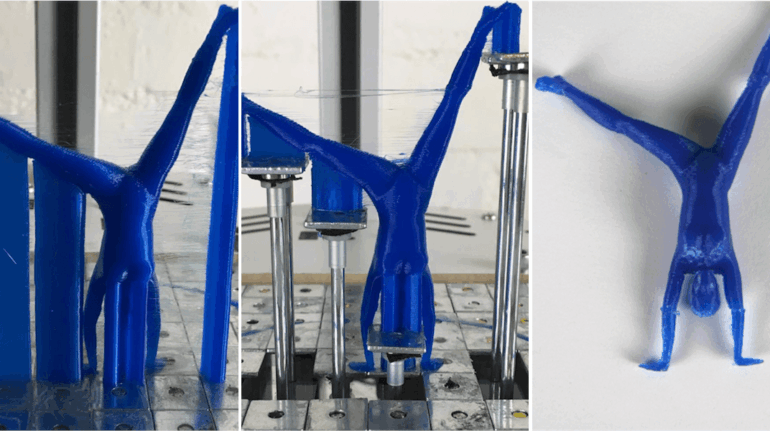
Dynamic 3D Printing Platform Concept Dramatically Reduces Supports in FFF

Dynamic 3D Printing Platform Concept Dramatically Reduces Supports in FFF

With a story published on April 1st (but we performed all the necessary anti-April Fools checks and can now confirm it), researchers in USC Viterbi’s Daniel J. Epstein Department of Industrial and Systems Engineering have revealed a low-cost reusable support method based on a dynamic 3D printing platform which reduces the need for wasteful supports in material extrusion/deposition, vastly improving cost-effectiveness and sustainability for 3D printing.
ExOne Joins AMGTA as a Founding Member

ExOne Joins AMGTA as a Founding Member

ExOne has joined the Additive Manufacturer Green Trade Association (AMGTA) as a founding member. ExOne joins AMGTA to collaborate in the effort to promote the environmental benefits of additive manufacturing (AM) in a variety of ways, including through rigorous and independent ongoing research.

INEOS R&D Creates Styrenics Polymer with 67% Energy Saving

INEOS R&D Creates Styrenics Polymer with 67% Energy Saving

An INEOS Styrolution research and development project reported an overall energy savings of up to 67% through the life cycle of a new styrenics polymer compound. The comparison styrenics compound was traditional Polyamide 12 (PA12). The massive savings derived from the new material benefits manufacturers and customers alike, let alone the wider environmental benefits supplied by energy-efficient products.

Ford and HP Reuse Spent 3D Printed Powders and Parts Sustainability

Ford and HP Reuse Spent 3D Printed Powders and Parts Sustainability

Ford teamed up with HP to reuse spent 3D-printed powders and parts, thus closing a supply chain loop and turning them into injection-molded vehicle parts. The recycled materials are being used to manufacture injection-molded fuel-line clips installed first on Super Duty F-250 trucks. The parts have better chemical and moisture resistance than conventional versions, are 7% lighter and cost 10% less. The Ford research team has identified 10 other fuel-line clips on existing vehicles that could benefit from this innovative use of material and are migrating it to future models.

How 3D Printing is Helping GE Research Turn air into water Industrial Additive Manufacturing

How 3D Printing is Helping GE Research Turn Air into Water

Water scarcity is a major global problem. More than 1.1 billion people do not have access to the liquid that sustains life, while nearly 3 billion experience water scarcity at some point (WWF). In an effort to combat this reality—which has the potential to worsen dramatically due to the climate crisis—GE Research is teaming up with the University of California at Berkeley, University of Chicago and University of South Alabama to develop a 3D printed device that can turn air into safe drinking water.

Elon Musk is Funding the $100M XPRIZE Carbon Removal and 3D Printing is Ready for the Challenge

Elon Musk is Funding the $100M XPRIZE Carbon Removal and 3D Printing is Ready for the Challenge

XPRIZE launched the $100M XPRIZE Carbon Removal sponsored by Elon Musk and the Musk Foundation and there is little doubt that 3D printing will accelerate and enable reaching this objective. This four-year global competition invites innovators and teams from anywhere on the planet to create and demonstrate a solution that can pull carbon dioxide directly from the atmosphere or oceans and lock it away permanently in an environmentally benign way.

First African 3D Printed Buildings Coming Up in Malawi to Support UN’s Sustainability Goals

First African 3D Printed Buildings Coming Up in Malawi to Support UN’s Sustainability Goals

3D printed buildings are popping up in more and more places, like the recent 3 floors apartment building in Germany but so far Africa has been only marginally on the map. 14Trees are about to change that. Established by LafargeHolcim, a world-leading provider of cement and concrete with 70,000 employees, 14Trees is focused on building affordable houses, schools and social infrastructures in Africa.

Canon Ecology Industry Makes 100% Recycled 3D Printing filament from used equipment Sustainability

Canon Ecology Industry Makes 100% Recycled 3D Printing Filament from Used Equipment

In a surprising and quite interesting turn of events, Canon Ecology Industry Co., Ltd. (a company founded in 2004 for the repair and regeneration of miscellaneous electrical and electronic equipment) has independently developed two types of filaments (PC-ABS, HIPS) for 3D printers made of 100% recycled plastic as the first in-house developed products. This filament is made from recycled plastic for the exterior of broken and old Canon multifunction devices, including copiers and toner cartridges collected from the market.

514be185946f3e74302346ee0e810c80.jpg

AMGTA commissions research project on the sustainability of metal AM Sustainability

The Additive Manufacturer Green Trade Association (AMGTA), a global trade group created to promote green benefits of additive manufacturing (AM), announced today that it had selected Jeremy Faludi, Ph.D., a leading researcher of sustainable engineering, to oversee its first commissioned university research project, a literature-based systematic review on the environmental sustainability of metal AM.

f101cc266b821ae31beab9d533f2a7b5.jpg

5 million Kg of ocean-bound plastic are now product-bound thanks to the Plastic Bank Sustainability

Think of her what you will (that she is moved by larger interest groups or that she is being used for notoriety) but there is no doubt that young Greta Thunberg is now in the global spotlight and has done more than anyone to raise awareness on the need for eco-sustainability. By bringing attention to the relative issue of global warming, she has also indirectly driven attention toward the real issue that is affecting life on this planet: pollution. Be it from CO2 emissions, radioactivity, poisonous chemicals or plastic. The issue of plastic pollution – and by extent ocean plastic pollution – is the one that concerns (or should concern) the AM industry more directly. Since 3D printing provided a new way to process plastic, it can be a part of the problem or a part of the solution. Plastic Bank, an entity created in 2013, has carried out some interesting activities to enable recycling of ocean-bound plastic in some of the world’s poorest communities, by attempting to transform used plastic into currency. In the organization’s initial idea, 3D printing was expected to play a part as a means to process used plastic. That may not have happened yet, however, it could, in the future, be used to process some of the 5 million kilograms of plastic that Plastic Bank has recovered over the past 6 years.