

Few films have made people inspect a piece of amber quite like Jurassic Park.
Suddenly, a small object with something visible inside became the beginning of an enormous story.
Transparent 3D printing offers a rather calmer version of that fascination. Instead of wondering what is trapped in a natural material, you can design what should be visible inside a physical model.
No dinosaurs required. The insurance paperwork is considerably simpler.

Give the Inside a Leading Role
Most models explain a subject through their outer shape.
Transparent models can also reveal relationships within that shape: where a structure sits, how it branches, and what surrounds it.
That is especially interesting for biology, where a surface view may conceal the very details you want to explain.
Color can help separate structures. Transparent regions can preserve context.
The goal is a model that gives the viewer a clearer way to understand the subject.
Preferably without someone having to say “imagine this part is invisible” every thirty seconds.
From Life Science Imagery to Physical Teaching Models
FacFox’s PolyJet biological embryo and vascular models provide a fitting starting point.
Embryological forms and branching vascular structures are subjects where three-dimensional relationships matter.
A physical model allows the viewer to change perspective, compare features, and discuss how structures relate spatially.
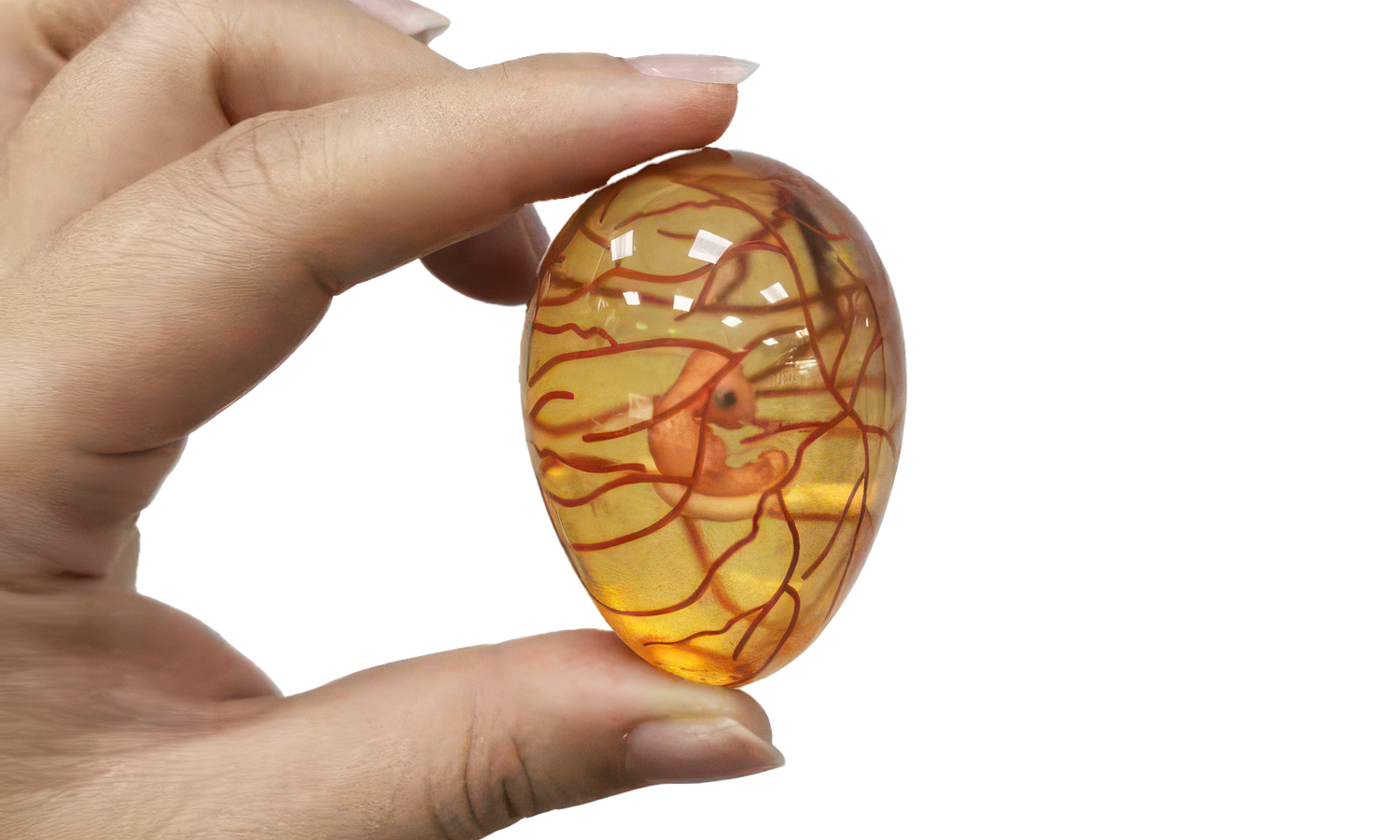
The connection to Jurassic Park is the visual fascination with life science. The real application is communicating biological form through a manufactured model.
A compelling display does not need to promise that anything inside will eventually hatch.
In fact, most classrooms would strongly prefer that it did not.
Transparency Changes How We Observe an Organ
FacFox’s transparent PolyJet kidney models show another use for clear material.
A familiar organ shape becomes something that can be examined through its volume rather than only around its outside.
The usefulness depends on what the digital model contains and how the printed surfaces are finished.

Transparency cannot reveal anatomical information that was never included in the design.
The model preparation is therefore as important as the material choice.
Clear resin is a visual tool, not an automatic source of biological accuracy.
Add Color Where It Helps
FacFox’s full-color half-brain model demonstrates how color and transparent regions can work together.
Different colors help distinguish areas, while transparency can preserve the relationship between an outer form and the structures within it.
For teaching and demonstration, that combination can make a complex explanation easier to follow.

FacFox offers PolyJet and transparent resin printing services for educational, anatomical, and visualization models.
Share your digital model, reference information, and teaching objective to discuss a suitable approach.
The next remarkable thing inside a transparent object might be a better explanation.
And unlike a theme park full of dinosaurs, that is a project worth keeping under control.
Leave A Comment
You must be logged in to post a comment