
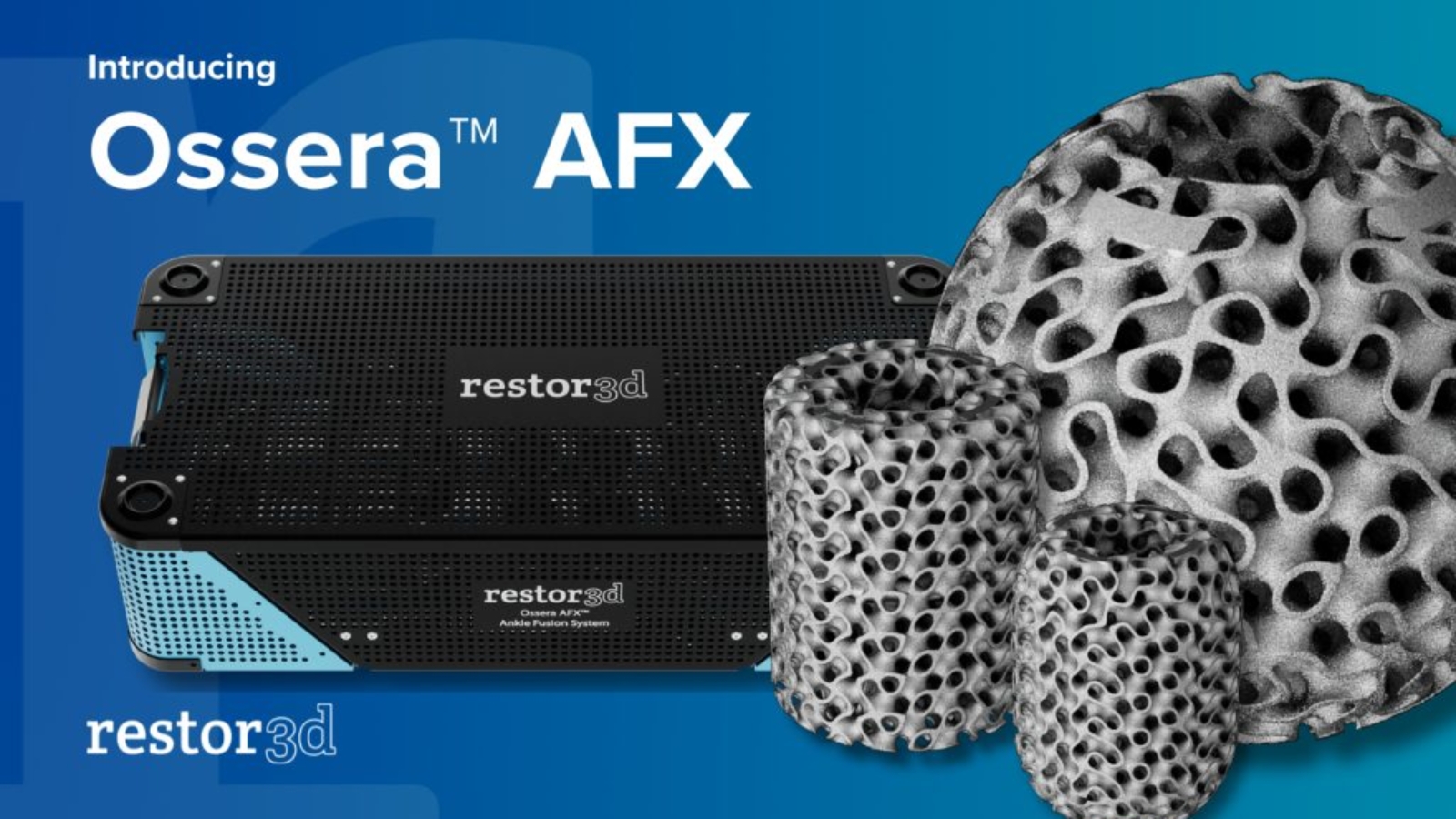
restor3d, a specialist in 3D printed personalized orthopedic solutions, has announced the full commercial release of the Ossera AFX Ankle Fusion Cage System. The platform, designed to address complex ankle fusion cases, is now available in both standard off-the-shelf and custom made-to-order configurations.
“We understand that every surgeon has unique preferences and approaches when it comes to patient care,” said Ken Gall, Chief Commercial Officer at restor3d. “That’s why we offer a comprehensive array of personalization options across our portfolio. Our goal is to ensure that every surgeon has access to the right tools to achieve the best possible outcomes.”
System Design and Features
After an initial restricted market rollout, restor3d has broadened the Ossera AFX portfolio with standardized implant options available in Cylinder, Dome, and Pill configurations. The geometries were developed using long-term analysis of patient case data to accommodate diverse anatomical requirements. Intended for foot and ankle surgery, the platform combines 3D printed titanium alloy implants, procedure-specific reusable instruments, and TIDAL Technology, the company’s porous structural design created to encourage bone integration.
 Ossera AFX. Image via restor3d.
“The Ossera AFX System is a readily available, standardized solution to deal with critical bone defects and has superior mechanical and osseointegration properties compared to allograft,” said Christopher Kreulen, MD. “The foot and ankle specific instrumentation and robust selection of sizes have significantly changed my complex limb salvage practice.”
The platform is designed for prompt clinical use, offering sterile-packaged implants and reusable instrumentation ready for immediate availability. Design elements, including cannulated reamers, flat cut guides, and lateral fibular relief integrated across implant configurations, aim to streamline procedures, promote consistent surgical outcomes, and allow adaptability during operations.
Challenges and Limits
Despite its design flexibility and personalization options, systems like Ossera AFX face several practical constraints. Producing 3D printed titanium implants with complex porous architectures requires precise process control and rigorous quality assurance to maintain consistent mechanical performance and biocompatibility. Variability in patient anatomy and surgeon technique can also influence how standardized geometries perform in real clinical settings.
Manufacturing on Demand
Operational considerations may also affect adoption. Managing both off-the-shelf and made-to-order inventory introduces logistical complexity for hospitals and distributors. In addition, integrating new implant systems into established surgical practices require adjustments in workflow, familiarity with specialized tools, and evaluation of long-term clinical results over time.
3D Printing Enables Solutions for Complex Cases
Complex orthopedic procedures like ankle fusion face challenges from irregular bone defects, diverse patient anatomies, and the necessity of achieving both stable fixation and effective bone integration. Traditional implants often cannot conform precisely to these anatomical variations, restricting surgical flexibility and potentially affecting long-term outcomes. Additive manufacturing overcomes these limitations by producing patient-specific implants with highly accurate geometries and engineered architectures that encourage osseointegration while maintaining mechanical strength.
Recent advances in medical 3D printing illustrate this potential. A 2025 study on 3D printed bone scaffolds demonstrated how porous lattice architectures can promote osseointegration and tissue regeneration. Similarly, a 3D printed total femoral replacement showed how patient-specific implants can address severe anatomical challenges where standard devices fail, preserving limb function and improving surgical outcomes. While these examples do not guarantee success in every patient or every case, they demonstrate that AM reliably overcomes key technical constraints, including anatomical variability, integration challenges, and mechanical performance.

 A 3D printed implant using polylactic acid. Photo via UNSW Canberra.
You might also like:
Nivalon Leverages AI and 3D Printing to Create Personalized, Motion-Preserving Spinal Implants: Conventional spinal implants typically come in preset metal sizes, but Nivalon’s approach tailors each device to the individual patient. Using CT scans, the implant is digitally modeled and 3D printed in ceramic to fit the patient’s spine precisely. This method aims to replicate the natural behavior of bone while minimizing complications commonly associated with metal implants, such as corrosion, uneven stiffness, ion release, and interference with imaging.
* This article is reprinted from 3D Printing Industry. If you are involved in infringement, please contact us to delete it.
Author: Paloma Duran
Leave A Comment