
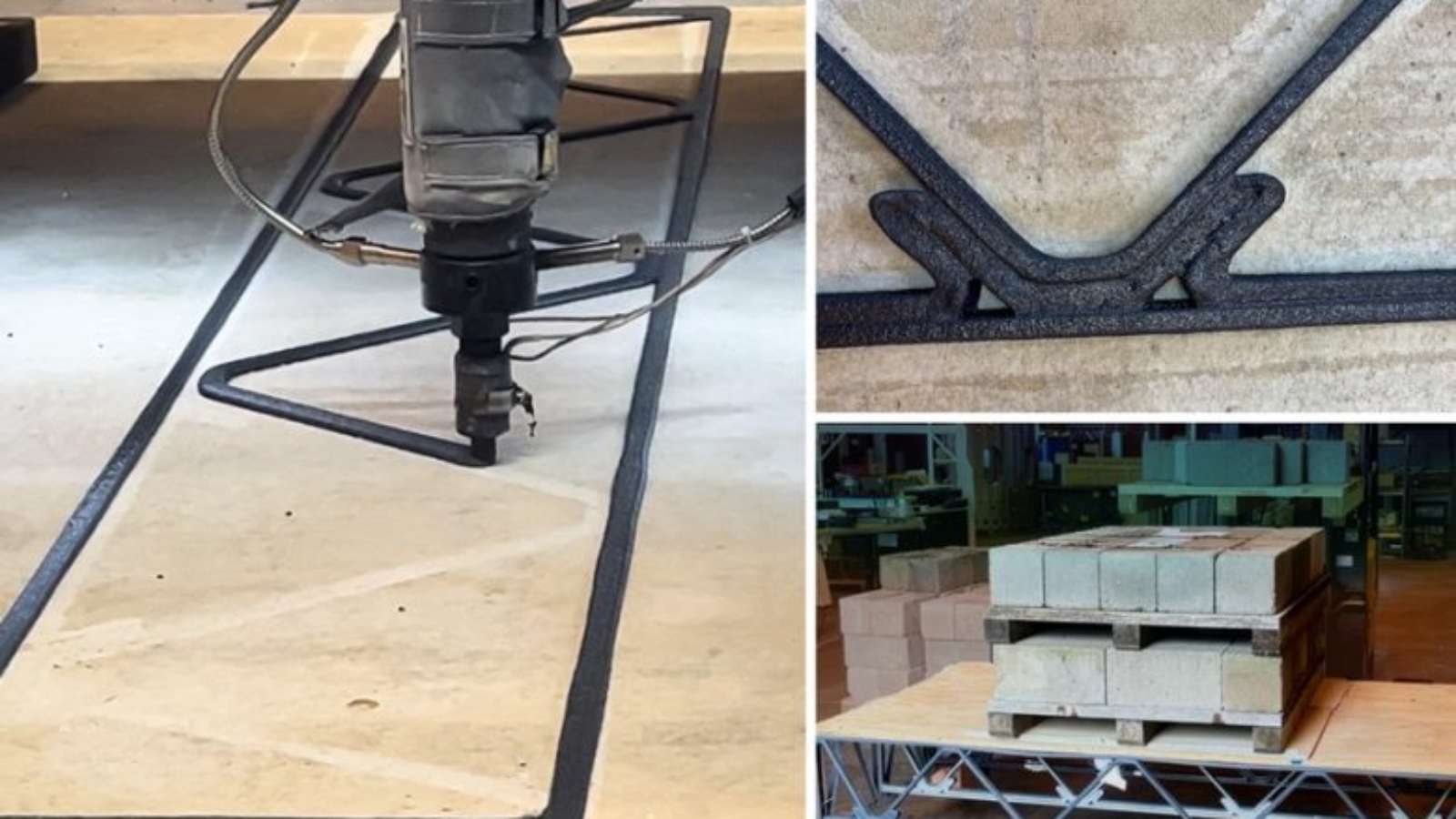
Engineers at the Massachusetts Institute of Technology (MIT) have developed a process for 3D printing construction-grade structural elements using recycled plastic.
The team’s design is for a 3D printed floor truss system, but load-bearing tests performed as part of their research indicate the system could be applied to the mass production of low-cost structures.
The project is exploring the use of LSAM to investigate the possibilities of a lighter, modular, and more sustainable alternative to traditional wood-based framing.
“We’ve estimated that the world needs about 1 billion new homes by 2050. If we try to make that many homes using wood, we would need to clear-cut the equivalent of the Amazon rainforest three times over,” stated AJ Perez, a lecturer in the MIT School of Engineering and research scientist in the MIT Office of Innovation.
Manufacturing on Demand
 Image: Massachusetts Institute of Technology
The team led by Perez 3D printed trusses using Airtech’s DALTHRAM-100GF, a 100% recycled copolyester with glass fiber reinforcement of 30%, and tested the structure’s load-bearing capacity in a conventional plywood-topped floor frame configuration. The printed floor was able to support over 4,000lb (more than 1,800kg), which exceeds key building standards set by the US Department of Housing and Urban Development.
Part of the team’s motivation is to be able to utilize “dirty” plastic – recyclable materials that don’t require cleaning or pre-processing.
“The key here is: We recycle dirty plastic into building products for homes that are lighter, more durable, and sustainable,” explained Perez. “We are starting to crack the code on the ability to process and print really dirty plastic. The questions we’ve been asking are: what is the dirty, unwanted plastic good for, and how do we use the dirty plastic as-is?”
You might also like:
Australian city to use carpet waste for 3D printed city infrastructure: The joint research project – with funding of AU$25,000 (US$17,500) – is targeting waste material from carpet manufacturing that typically goes to landfill, to see if it can be transformed into viable feedstock for additive manufacturing. If successful, the initiative could divert hundreds of tonnes of waste annually.
* This article is reprinted from 3D Printing Media Network. If you are involved in infringement, please contact us to delete it.
Author: Joseph Caron-Dawe
Leave A Comment
You must be logged in to post a comment