
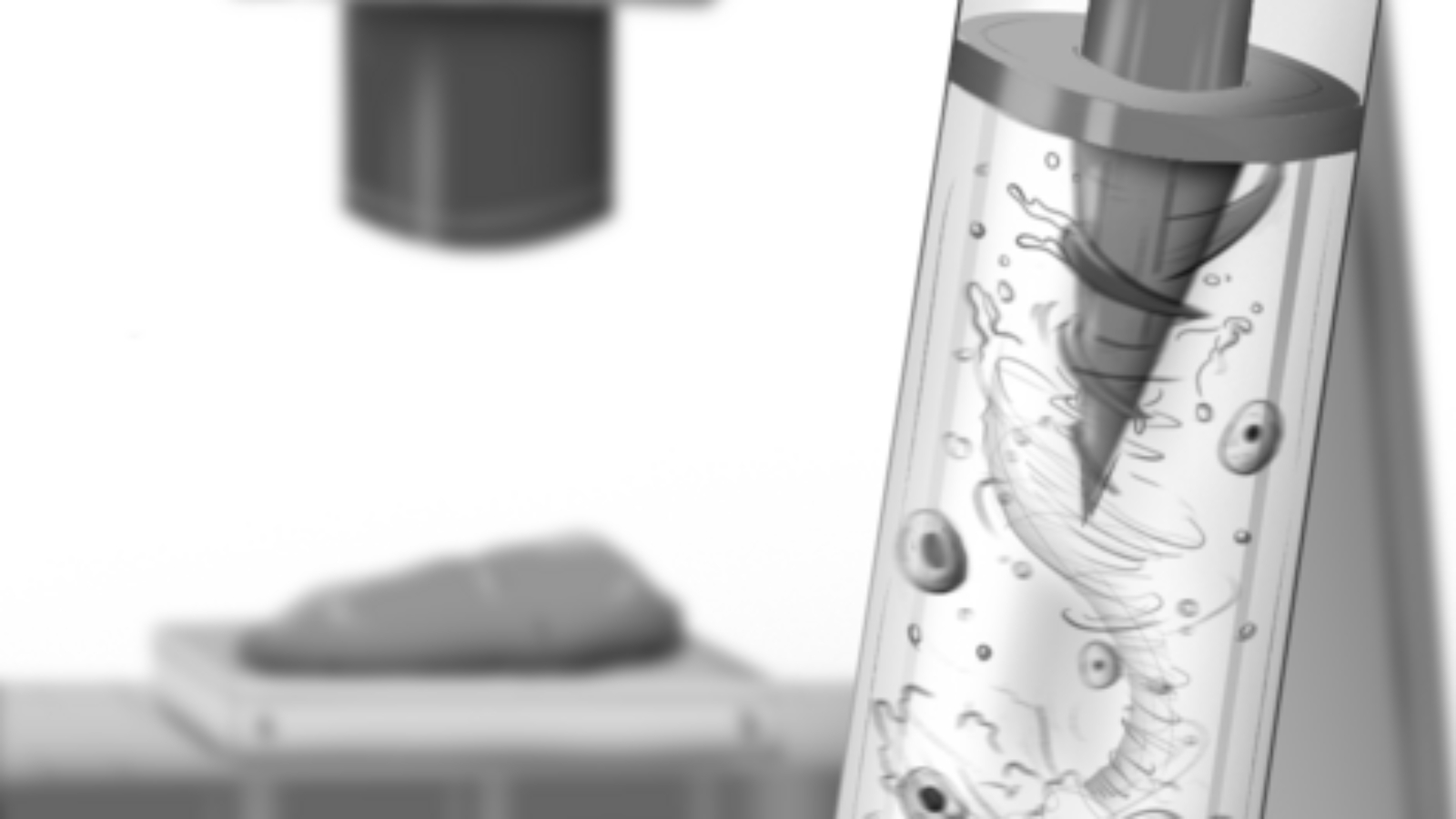
Researchers at the Massachusetts Institute of Technology (MIT) have created MagMix, a compact magnetic system that actively prevents cell settling during 3D bioprinting, producing more uniform and functional tissues. The innovation addresses a key limitation in biofabrication: sedimentation in bioinks—a mixture of living cells and hydrogels—which can cause clogging, uneven cell distribution, and inconsistent tissue quality, making it difficult to print large or complex tissues reliably.
The project received support from MIT’s Safety, Health, and Environmental Discovery Lab (SHED), which provides technical infrastructure and interdisciplinary expertise for scaling lab innovations. “MagMix is a strong example of how the right combination of technical infrastructure and interdisciplinary support can move biofabrication technologies toward scalable, real-world impact,” says SHED founding director Tolga Durak.
 MagMix, a magnetically actuated mixer. Image via MIT.
A New Approach: Active Magnetic Mixing
In a study published February 2, Ritu Raman, Eugene Bell Career Development Professor of Tissue Engineering at MIT, and her team describe a method that actively prevents cell sedimentation during printing, ensuring more consistent and biologically viable tissues. “Precise control over the bioink’s physical and biological properties is essential for recreating the structure and function of native tissues,” says Ferdows Afghah, a postdoc in mechanical engineering at MIT and lead author of the study.
MagMix consists of a small magnetic propeller placed inside standard printer syringes and a motor-driven permanent magnet outside. This compact setup can be attached to any conventional 3D bioprinter, ensuring bioinks remain evenly mixed throughout printing without altering their composition or affecting the printer’s standard functions. The researchers first used computer simulations to determine the ideal propeller shape and rotation speed, and then confirmed its effectiveness through experimental tests.
“Across multiple bioink types, MagMix prevented cell settling for more than 45 minutes of continuous printing, reducing clogging and preserving high cell viability,” says Raman. “Importantly, we showed that mixing speeds could be adjusted to balance effective homogenization for different bioinks while inducing minimal stress on the cells. As a proof-of-concept, we demonstrated that MagMix could be used to 3D print cells that could mature into muscle tissues over the course of several days.”
Applications in Medicine and Beyond
By keeping cells evenly distributed, MagMix enables production of higher-quality tissues with consistent biological function. Its compact, customizable design makes it compatible with existing 3D printers, offering an accessible solution for laboratories and companies working on disease modeling, drug testing, and regenerative medicine.
The team also sees potential beyond healthcare. Printed muscle tissue could power safer and more efficient biohybrid robots, while regenerative medicine applications aim to replace diseased or injured tissues with 3D printed constructs that restore healthy function.
Manufacturing on Demand
 MagMix, a magnetically actuated mixer. Image via MIT.
Limits and Challenges
While MagMix improves cell distribution, it does not eliminate all sources of variability in 3D bioprinting. Its effectiveness has been validated for up to 45 minutes of continuous printing and across multiple bioinks, but longer sessions or untested formulations may behave differently. The system maintains homogeneity within the syringe but does not address downstream tissue maturation, vascularization, or integration in living organisms. Additionally, scaling to industrial or clinical production will require further validation, standardization, and regulatory approval before it can be applied in therapeutic or commercial settings.
Addressing Bioprinting Challenges
Maintaining even cell distribution in bioinks is one of the biggest challenges in 3D bioprinting, directly affecting tissue quality and reproducibility. Besides MIT, researchers are tackling this through high cell‑density bioinks that support stem cells in forming stable cartilage and bone regions, improving construct integrity.
Companies like BIO INX and Readily3D have developed ready‑to‑use formulations optimized for volumetric printing, reducing handling variability and improving cell viability. These advances highlight the growing focus on controlling bioink behavior and printer handling, preventing cell sedimentation and producing more consistent, biologically viable tissues.
You might also like:
Teams Selected by ARPA-H to Develop Patient-Specific Bioprinted Organs: The initiative aims to produce human-sized, fully functional organs within hours, addressing the urgent shortage of transplantable organs in the United States, where thousands of patients die annually while waiting.
* This article is reprinted from 3D Printing Industry. If you are involved in infringement, please contact us to delete it.
Author: Paloma Duran
Leave A Comment