
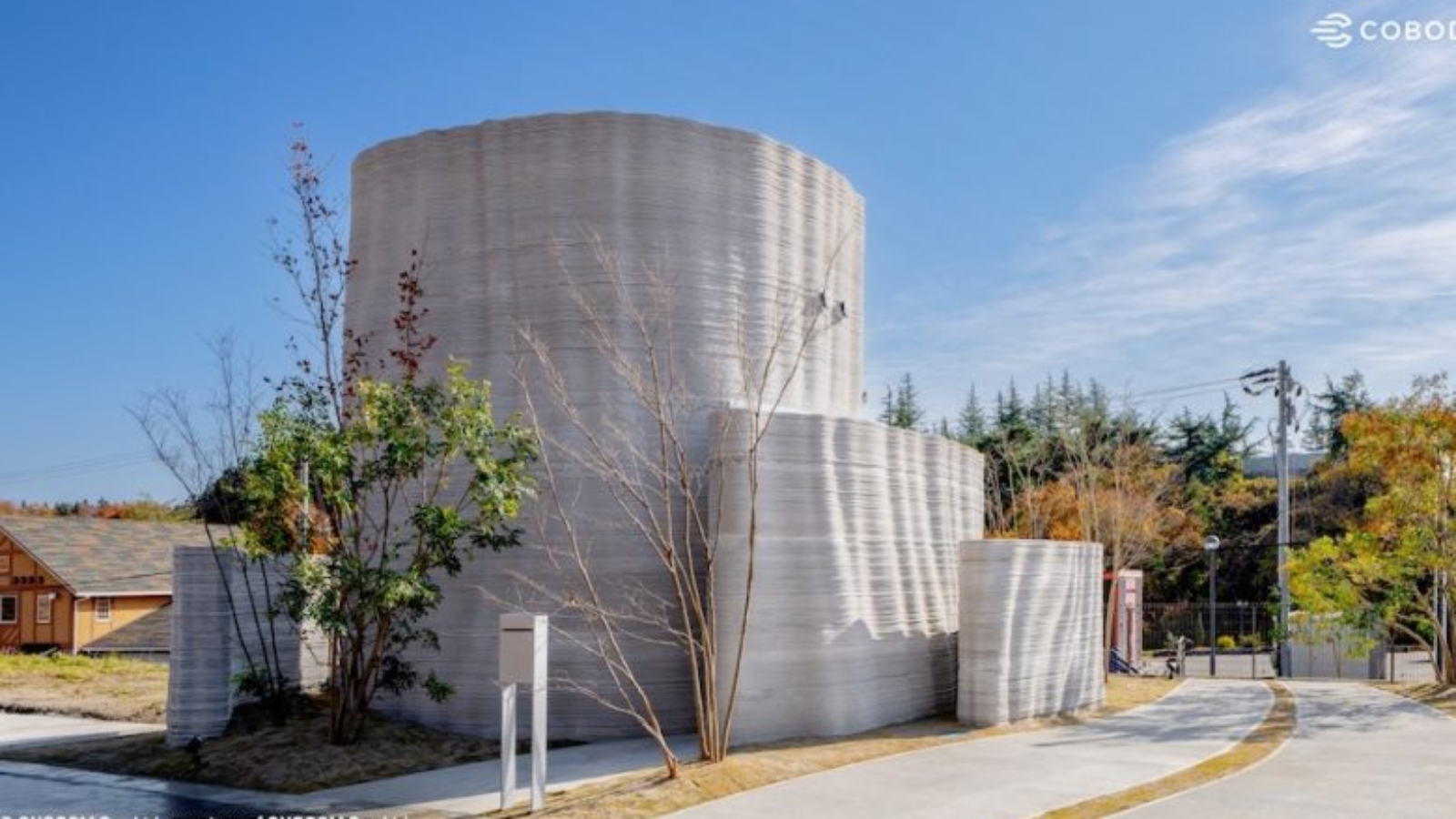
As a country that experiences upwards of 500,000 earthquakes every year, Japan is correct to have highly stringent building requirements. These requirements—the New Anti-seismic Structure Standard from 1981 in particular— ensure that only buildings with earthquake-resistant structures are erected. In a milestone for the emerging construction 3D printing sector, the first two-story 3D printed home has been approved by Japan’s government based on these standards, demonstrating that reinforced 3D printed concrete is a valid construction material for earthquake-resistant homes.

The build was led by Kizuki Co. Ltd., which leveraged COBOD’s large-scale 3D printing technology to erect the 50-square-meter two-story home. The hardware used was a customized configuration of COBOD’s gantry-style technology adapted to print from 0.5 meters below ground to a total height of seven meters. The home itself consists of two floors: the ground floor spans 31 square meters, while the upper level covers 19 square meters. The architectural design of the house was inspired by caves and integrates a series of 3D printed arches along with 3D printed floor and roof slabs. A number of interior elements were also 3D printed to bring the signature curved structure of the home indoors.
3D printing was key to achieving this unique cave-inspired look and Kizuki employed a dual approach, combining on-site and off-site production to create the architectural forms. For instance, the arches were 3D printed longitudinally on site to avoid logistics challenges associated with transporting them. Kizuki also employed CNC-cut styrofoam supports throughout the build to allow the printer to create overhangs up to 90 degrees without obstructing the toolpath. As we can see, the house has embraced the layered aesthetic of the printing process, however some wall sections were polished.
Manufacturing on Demand
Beyond the design, the biggest achievement of this two-story home is that it showcases the potential for construction 3D printing to create compliant homes in Japan. Traditionally, Japan’s construction sector has relied on timber frames, which require a high level of craftsmanship and extensive labor. This has increasingly brought challenges in the country, which is faced by demographic changes and an aging workforce. With construction 3D printing emerging as an alternative solution, the construction industry could embrace a more automated process that is less dependent on manual labor. (In the case of the two-story home, for instance, a crew of just four people was required.)

Henrik Lund-Nielsen, Founder and General Manager of COBOD International, said of the achievement: “Japan has some of the most demanding seismic requirements in the world. Seeing a government-approved two-story 3D printed reinforced concrete house completed here confirms that 3D construction printing is ready for projects that rely on structural precision and consistent quality, also in seismic areas. Kizuki’s project shows how our technology handles complex geometry, varying climate conditions, and strict regulatory standards.”
 Kizuka plans on taking the knowledge it has gained through both the building and regulatory processes into the future as it advances construction 3D printing development. According to the company it will continue to evaluate applications where seismic resistance, build speed and automation are vital. As Rika Igarashi, CEO of Kizuki, explained: “Based on the knowledge gained through our recent residential construction project, we plan to expand the application of 3D printing technology into civil structures, disaster-prevention and defense infrastructure, and post-disaster reconstruction. We are also developing a construction training program and a digital construction management system, aiming to establish a sustainable construction-industry model.”
The earthquake-resistant 3D printed home is not the first example of construction 3D printing being used to create more resistant structures. In Buena Vista Colorado, a region at high risk of wildfires, construction tech company VeroTouch has 3D printed a series of fire-resistant homes using COBOD’s BOD 2 3D printer and an A1-rated concrete. Similarly, just north of San Francisco, Enterprise Park and Emergent3D turned to the latter’s concrete 3D printing to rebuild a community that was devastated by wildfires.
You might also like:
Sustainable, load-bearing printable concrete being developed in Singapore: The researchers, led by Senior Lecturer Du Hongjian and Associate Professor Pang Sze Dai from the Department of Civil and Environmental Engineering, developed a process that demonstrated 3DCP’s ability to meet structural performance standards while reducing reliance on formwork and manual labor.
* This article is reprinted from 3D Printing Media Network. If you are involved in infringement, please contact us to delete it.
Author: Tess Boissonneault
Leave A Comment
You must be logged in to post a comment