
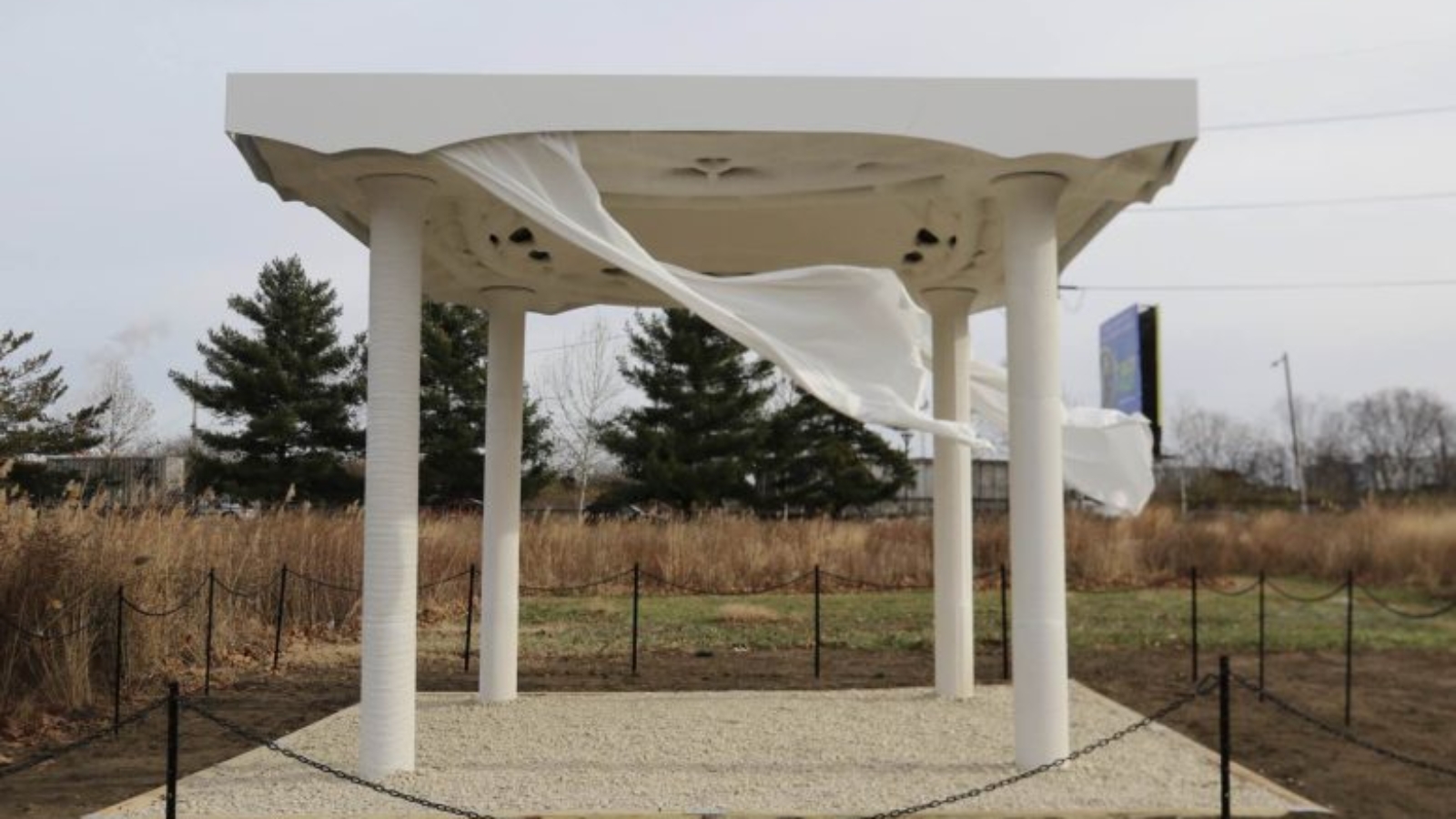
A team of researchers from the Polyhedral Structures Laboratory at the University of Pennsylvania has unveiled a new flooring installation that demonstrates how 3D printing and cutting-edge design can be combined to create structures that significantly reduce concrete consumption and, consequently, the carbon footprint of construction. The project, called “3D-Printed Dual-Banded High-Performance Concrete Floor”, is led by Dr. Masoud Akbarzadeh, Associate Professor of Architecture and director of the Polyhedral Structures Laboratory (PSL).
Concrete represents a huge proportion of our global carbon emissions, contributing in the range of 8% of total carbon emissions in 2021. Yet, as the need for housing and infrastructure continue to grow, the demand and need for the carbon-consuming material remains high. There are thus efforts to decarbonize concrete by using more ecological materials in concrete mixes, using the material more efficiently, and integrating carbon capture into the material’s life cycle.
Manufacturing on Demand
 (Photo: PSL | University of Pennsylvania)
 The Penn-based project demonstrates how robotic 3D printing and innovative design paradigms can reduce the ecological impact of built structures through efficient material use and increased potential for carbonation. In more specific terms, the researchers have developed a 3D printed floor system that integrates five funicular elements assembled into a lightweight structure with dual-banded post tensioning. This results in a flooring structure that reduces concrete volume by 40%, increases the surface area for carbonation by over 65%, and reduces post-tensioning reinforcement by 81% (based on the PTI Manual) compared to a 9-inch-thick conventional post-tensioned concrete slab.
A prototype of the innovative flooring was recently unveiled at the University of Pennsylvania. This large structure was made using a five-axis robotic 3D printer. Built upon a conventional foundation, the structure consists of 24 printed segments and four prefabricated capitals, which connect the floor to a series of four supporting columns. These columns were also 3D printed and each is made up of three sections. According to the researchers, the exterior 3D printed shell of each column functions as lost formwork “enclosing conventional in-situ concrete and reinforcement to meet structural, durability, and code requirements”.
 (Photo: PSL | University of Pennsylvania)
“We have just opened a new exhibition at Pennovation, University of Pennsylvania, showcasing a 3D printed funicular floor system that establishes a new structural paradigm,” said Dr. Masoud Akbarzadeh on LinkedIn. “The system integrates geometry-based efficiency, digital fabrication, and modular dual-banded post-tensioning to substantially reduce material demand, embodied carbon, and energy use. The structure will be open to the public for the next six months.”
You might also like:
SCG completes 3D printed pedestrian bridge in Bangkok’s Ong Ang Canal district: Located in Bangkok’s old town, the Ong Ang Canal has long been central to the city’s history, first as a defensive moat and later as a vital commercial waterway. The new pedestrian bridge reinterprets that legacy through an architectural language inspired by water’s motion. Its sculptural form rises and folds like a wave, connecting the canal’s two banks while softening the visual weight of concrete in a dense urban setting.
* This article is reprinted from 3D Printing Media Network. If you are involved in infringement, please contact us to delete it.
Author: Tess Boissonneault
Leave A Comment
You must be logged in to post a comment