
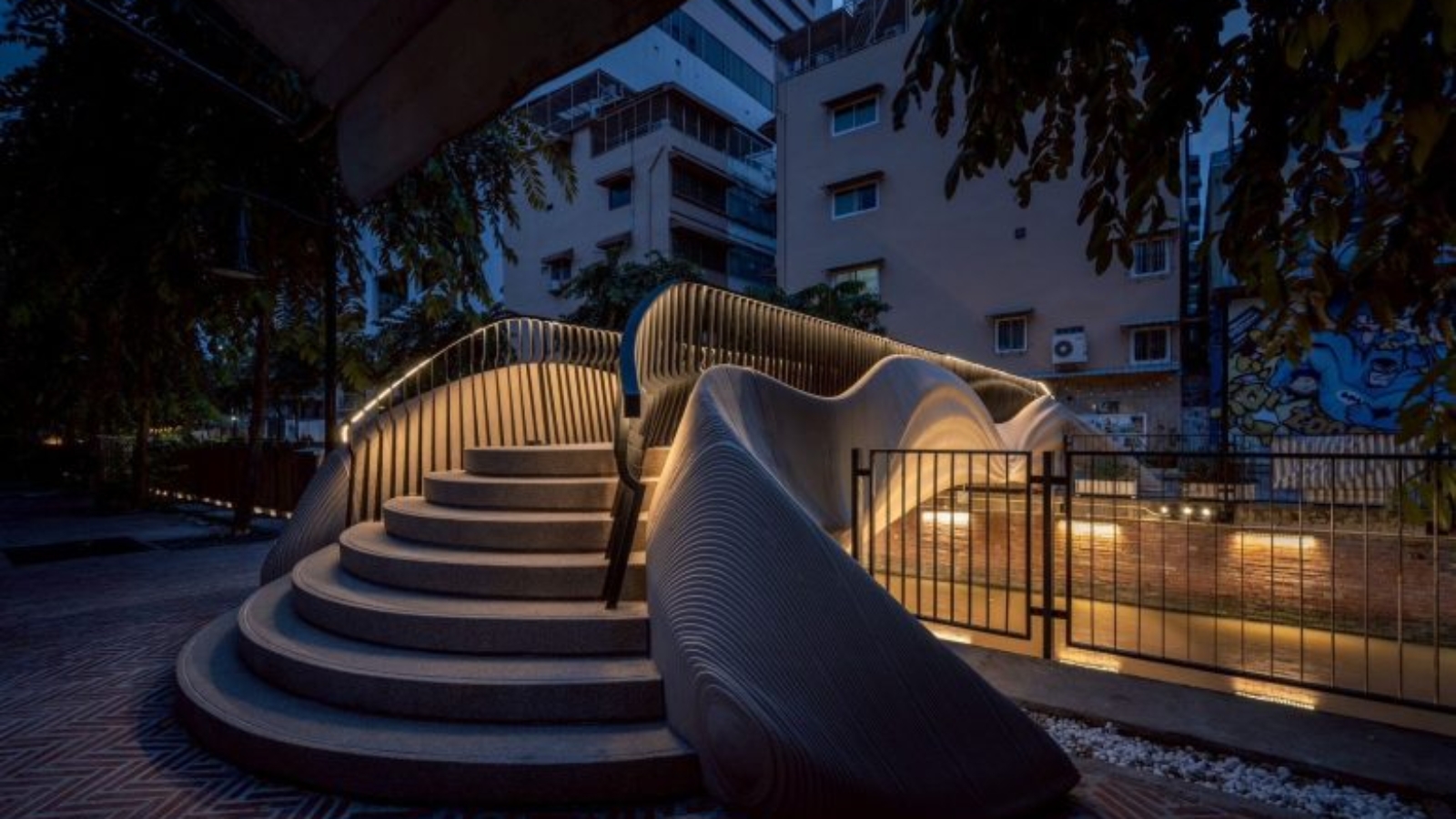
SCG has completed a 3D printed pedestrian bridge spanning Bangkok’s historic Ong Ang Canal, marking one of Thailand’s first uses of large-scale digital fabrication for public infrastructure. The project, finished in 2025 under the Bangkok Metropolitan Administration’s canal revitalization program, combines architectural innovation with local cultural references and sustainability-focused materials research.
 Bridging heritage and innovation
Located in Bangkok’s old town, the Ong Ang Canal has long been central to the city’s history, first as a defensive moat and later as a vital commercial waterway. The new pedestrian bridge reinterprets that legacy through an architectural language inspired by water’s motion. Its sculptural form rises and folds like a wave, connecting the canal’s two banks while softening the visual weight of concrete in a dense urban setting.
Manufacturing on Demand
Designed and built by SCG, the bridge’s fluid shape and continuous curves reflect the canal’s natural rhythm, with light playing across its undulating surfaces. A steel railing features lines derived from the traditional Thai Kranok motif, linking contemporary design with the area’s cultural heritage.
Walking on sustainable materials
All bridge components were 3D printed using a low-carbon concrete known as LC3, which replaces part of the cement with calcined clay to reduce embodied carbon. The use of clay echoes Ong Ang’s past as a center for pottery and earthenware trade, reinforcing the project’s cultural continuity. Each printed segment was reinforced with high-performance concrete to achieve a live load capacity of 500 kilograms per square meter.
Because the site offered limited access, the bridge was prefabricated off-site and assembled from 19 modular segments, each weighing approximately 1.5 tons. Installation was completed in a single day with a small crane, minimizing disruption to surrounding communities.
You might also like:
MiCoB delivers 500+ 3D printed bunkers to the Indian Army: Each bunker has been designed by MiCoB in close alignment with the operational needs of Army personnel deployed in extreme and sensitive locations. From high-altitude hilly and snow-clad terrains to sand dunes of deserts, these 3D printed bunkers (also called Permanent Defences (PDs)) provide superior protection, comfort, and durability while meeting stringent military standards for ballistic resistance, speed of execution, and thermal insulation.
* This article is reprinted from 3D Printing Media Network. If you are involved in infringement, please contact us to delete it.
Author: Davide Sher
Leave A Comment
You must be logged in to post a comment