
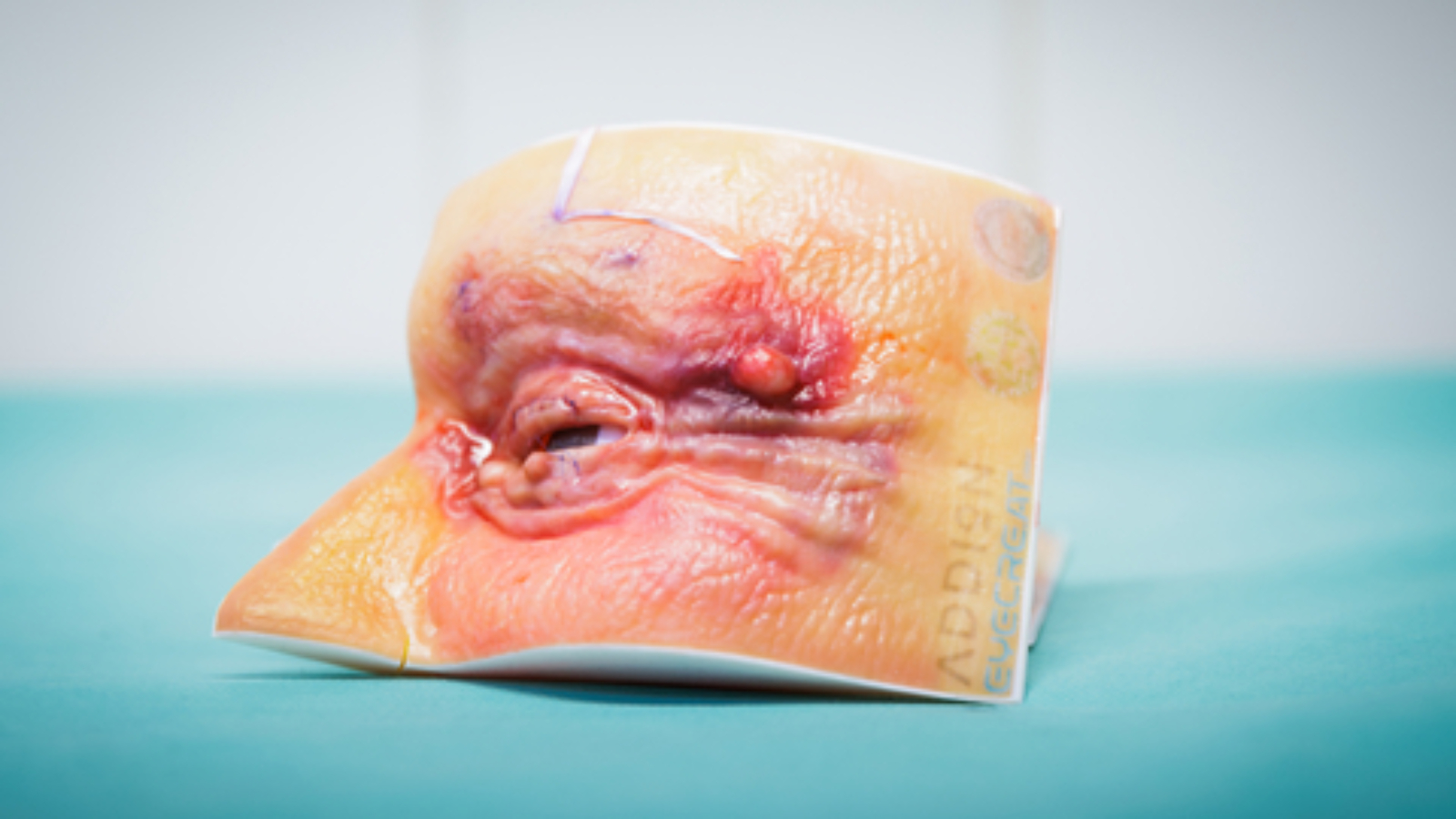
Austrian medical training and innovation firms Addion and Eyecer.at have begun using 3D printer OEM Stratasys’ Digital Anatomy Solution to create 3D printed anatomical eye models for training in eyelid surgery.
Leveraging Stratasys PolyJet 3D printing technology, Addion is producing detailed 3D printed replicas of the human eye and surrounding tissues, including skin, muscle, and fat. Described as “Europe’s first,” these models are designed to mimic realistic anatomical behavior and will be used at the Anatomical Institute of the University of Innsbruck to support surgical training that demands precision and familiarity with delicate structures.
The technology also enables the creation of models representing rare or complex conditions, giving trainees experience with a broader range of cases, from reconstruction after trauma or previous surgery to aesthetic procedures. Addion has additionally incorporated simulated blood flow within the printed tissue to reproduce visual and tactile aspects of real operations in a controlled and repeatable setting.
“We can now simulate rare and complex pathologies in a way that is ethical, reproducible, and remarkably realistic,” said Alexander Hechenberger, CEO and founder of Addion GmbH. “By eliminating the need for cadavers or animal models, medical institutions no longer require chilled facilities, while benefiting from safe, consistent, and cost-effective training, without sacrificing the quality of the model.”
The 3D printed eyelid surgery models and other medical applications were featured live at Formnext 2025, where visitors could join Stratasys experts for hands-on demonstrations and discussions on the future of medical 3D printing.
 Addion’s 3D printed anatomical eye model for training in eyelid surgery. Photo via Addion.
Growing adoption of Digital Anatomy Solution in clinical training
As of now, several hospitals, universities, and medical device developers are using Stratasys’ Digital Anatomy Solution for training, patient communication, device evaluation, and surgical planning. The manufacturer says it offers a dependable, scalable training approach that helps reduce costs and ease logistical demands.
In 2023, it was announced that Stratasys and Ricoh began offering on-demand, patient-specific anatomical models using the Digital Anatomy Solution, which mimics the biomechanical properties of real tissue and bone. Medical scans can be uploaded to a secure cloud platform, where Axial3D’s AI-powered software converts them into printable files that Ricoh manufactures in its ISO 13485-certified facility.
The service delivers models within days, enabling surgical planning, diagnosis, education, and care-team communication without requiring hospitals to maintain their own 3D printing equipment or expertise, while expanding access and reducing costs.
More recently, Stratasys and Siemens Healthineers introduced patient-specific 3D printed CT phantoms that more accurately reproduce human anatomy for imaging research and surgical planning.
Manufacturing on Demand
By integrating Stratasys RadioMatrix materials and Digital Anatomy technology with Siemens’ imaging algorithms, the partners can now produce anatomically realistic phantoms with precise radiopacity that outperform traditional models. The resulting consistent, repeatable datasets support clinical use and AI development and have demonstrated deviations of only single Hounsfield units in key regions, improving diagnostic reliability.

 Axial CT scan comparison. Photo via Stratasys/Siemens Healthineers.
Advanced models guide complex procedures
This growing ecosystem of digital and printed anatomical tools is now influencing surgical planning across multiple specialties.
Two years ago, 3D printing service bureau Materialise introduced Mimics Planner, a thoracic surgery platform that uses advanced 3D modeling and AI-driven CT segmentation to speed up preparation for segmentectomy and lobectomy procedures. The software produces detailed 3D views of lesions, surrounding anatomy, and intersegmental planes within minutes, reducing the effort and errors of manual segmentation.
Surgeons can explore the anatomy interactively, compare models with CT scans, and review clearly labeled segments from any device. Compatible with non-contrast CT data and usable for VR training, the platform also meets GDPR and HIPAA security requirements.
Elsewhere in Australia, a surgical team at The Prince Charles Hospital used a full-scale 3D printed replica of a patient’s massively enlarged aorta to plan a complex aorta replacement procedure. The model was produced by the Herston Biofabrication Institute (HBI) using digital scans and a Stratasys J750 Digital Anatomy 3D printer, which printed multiple material textures to mimic real tissue.
This allowed surgeons to map the patient’s anatomy more precisely before performing a nine-hour operation involving circulatory arrest and graft implantation. The patient is recovering well, and HBI is developing future models that simulate blood flow for even more realistic surgical rehearsal.
You might also like:
Nimble: A Modular 3D Printed Prosthetic Fin for Swimmers: “The Nimble prosthetic fin redefines mobility for below-the-knee amputees. At its core is an innovative, 3D printed flexible lattice structure. This centerpiece is engineered to reduce stress on the user’s limb while simultaneously generating powerful thrust with each kick, all within an incredibly lightweight carbon fiber construction,” said the studio.
* This article is reprinted from 3D Printing Industry. If you are involved in infringement, please contact us to delete it.
Author: Ada Shaikhnag
Leave A Comment