
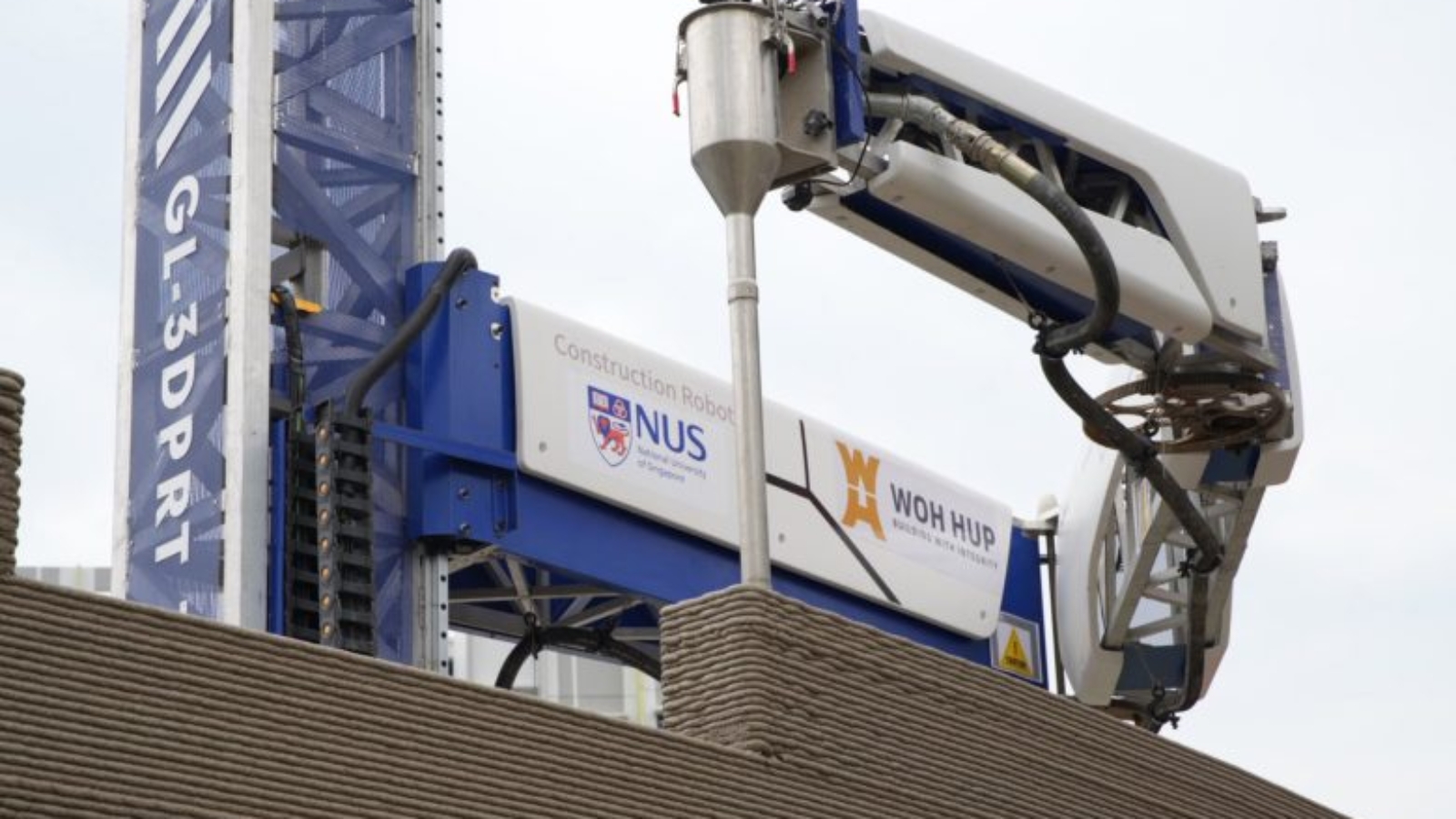
A team working on a sustainable, structurally-reinforced 3D printable concrete at the National University of Singapore has demonstrated viability for load-bearing components, in the country’s first on-site structural deployment.
The researchers, led by Senior Lecturer Du Hongjian and Associate Professor Pang Sze Dai from the Department of Civil and Environmental Engineering, developed a process that demonstrated 3DCP’s ability to meet structural performance standards while reducing reliance on formwork and manual labor.
Working with construction firm Woh Hup, the uni team also received support from Singapore’s Building and Construction Authority and the National Additive Manufacturing Innovation Cluster, and made the first on-site 3DCP deployment of structural elements in August 2025. That exercise was BCA verified, and a second on-site printing process began last week.
Key findings to date have included the total elimination of conventional formwork, which typically means custom molds for each structural component. The new approach delivered more than 40% manpower savings and efficiency gains that exceed 60% for complex components, according to industry evaluations.
The results also indicate that 3DCP uses 30% less material than conventional construction technologies.
Manufacturing on Demand
The concrete mixes were optimized for extrusion and build integration, while maintaining compatibility with existing prefabrication workflows. Both laboratory and large-scale tests confirmed that reinforced 3DCP elements could achieve the required load-bearing performance while using less material than conventional designs.
“Working directly with industry partners enables us to test these technologies against real constraints and build confidence for wider adoption,” stated Pang.
“This project was ground-breaking as it was the first in Singapore to be carried out on site for structural elements,” added Er Lim Kheng Guan, Deputy Director from BCA’s Building Engineering Group. “As the BE sector’s champion for innovation and collaboration, BCA supported the project team and facilitated the implementation of the technology. The success of this project also positions Singapore as a regional leader in construction innovation and opens numerous possibilities for future development.”
In parallel to this work, the researchers also developed a 3D printable concrete mix that replaces 60% of ordinary Portland cement with recycled waste glass powder. Lab tests proved the material could be 3D printed into full-scale elements, while achieving compressive strengths exceeding 50 megapascals.
The mix also reduced embodied energy by 44%, and carbon dioxide emissions by 52%, compared with conventional printable concrete. Tests also showed improved resistance to chloride penetration, which could result in extended service life.
Development work has previously been done on 3D printable sustainable alternatives to concrete, but without establishing the level of structural robustness found in the NUS research. Concrete that can be 3D printed underwater is also currently being investigated by a team at Cornell.
You might also like:
Two-story 3D printed home passes Japan’s stringent seismic standards:
* This article is reprinted from 3D Printing Media Network. If you are involved in infringement, please contact us to delete it.
Author: Joseph Caron-Dawe
Leave A Comment
You must be logged in to post a comment