
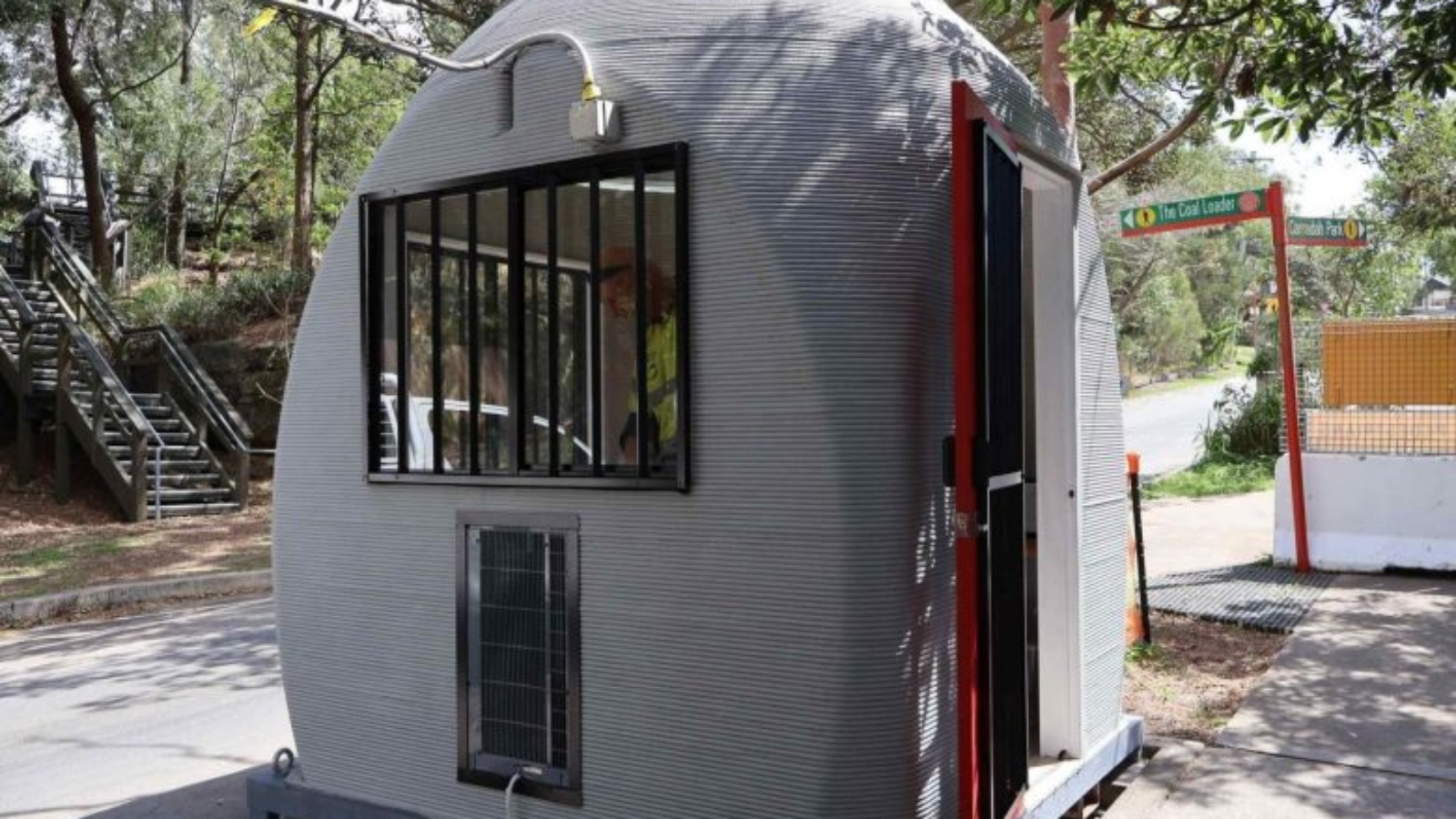
ACCIONA, a renewable energy and sustainable infrastructure solutions company headquartered in Spain, has deployed 3D printed traffic control and security huts in Australia as part of a trial.
The installation on the New South Wales Government’s Western Harbour Tunnel project in Sydney also marks a first for the company in terms of the type of structure, which it says is “unusual in the broader infrastructure sector”.
The huts are constructed from patterned, contoured concrete that is fully recyclable. Unlike conventional alternatives, the material can be deconstructed and combined with other materials to form new structures, directly supporting circular construction principles and reducing waste on site.

Manufacturing on Demand
Each unit weighs approximately 2.4 tonnes and is mounted on a plinth, allowing relocation as site requirements evolve. Production takes around nine days per hut — an estimated 40 to 50% reduction in build time compared with conventional construction methods. The huts come fully equipped with lighting and power and cost 40 to 50% less than standard traffic control and security huts.
Two units are currently in use at the Berrys Bay and Cammeray sites in Sydney, with early feedback described by ACCIONA as positive. The huts were manufactured at a factory in Cronulla using technology developed by Contour3D.
Security Lead Duncan Kerr, who led the initiative, said the team identified clear advantages from the outset.
“This was a great opportunity to trial something completely different,” stated Kerr. “The speed of delivery, cost savings, and sustainability benefits really stood out, and the fact that the huts are fully recyclable aligns strongly with our project and business values.”
You might also like:
Milan’s Bergamo Airport opens 3D printed service building: The 3D printed structure, dubbed Ol Casél, is located within the airport’s Logistics Park and functions both as a service module and rest area for personnel in the airport’s customs sector. 3D printing was chosen as the construction method for this structure for a few reasons. For one, it accelerated construction lead times. In fact, the service module was reportedly finished in record time, requiring just 19 days to be completed (only seven of which were printing days).
* This article is reprinted from 3D Printing Media Network. If you are involved in infringement, please contact us to delete it.
Author: Joseph Caron-Dawe
Leave A Comment
You must be logged in to post a comment