
Fiberglass-reinforced plastic (FRP) is a composite of two components:
- Resin matrix (typically unsaturated polyester resin): provides shape, rigidity, and surface finish
- Glass fiber reinforcement (woven cloth or chopped mat): embedded in the resin to provide tensile strength and prevent cracking
The analogy to reinforced concrete is exact: resin is the concrete, fiberglass is the rebar. During manufacturing, liquid resin cures via a chemical cross-linking reaction — it does not melt the fiber, but permanently encapsulates it. FRP sculptures are lightweight, weather-resistant, corrosion-proof, and accept a wide range of surface finishes, from mirror chrome to hand-painted detail.
FacFox offers end-to-end FRP sculpture manufacturing — from prototype development and mold-making through to surface finishing and delivery. This guide walks through how the process works and what to consider when planning your project.
The Two Paths to an FRP Sculpture
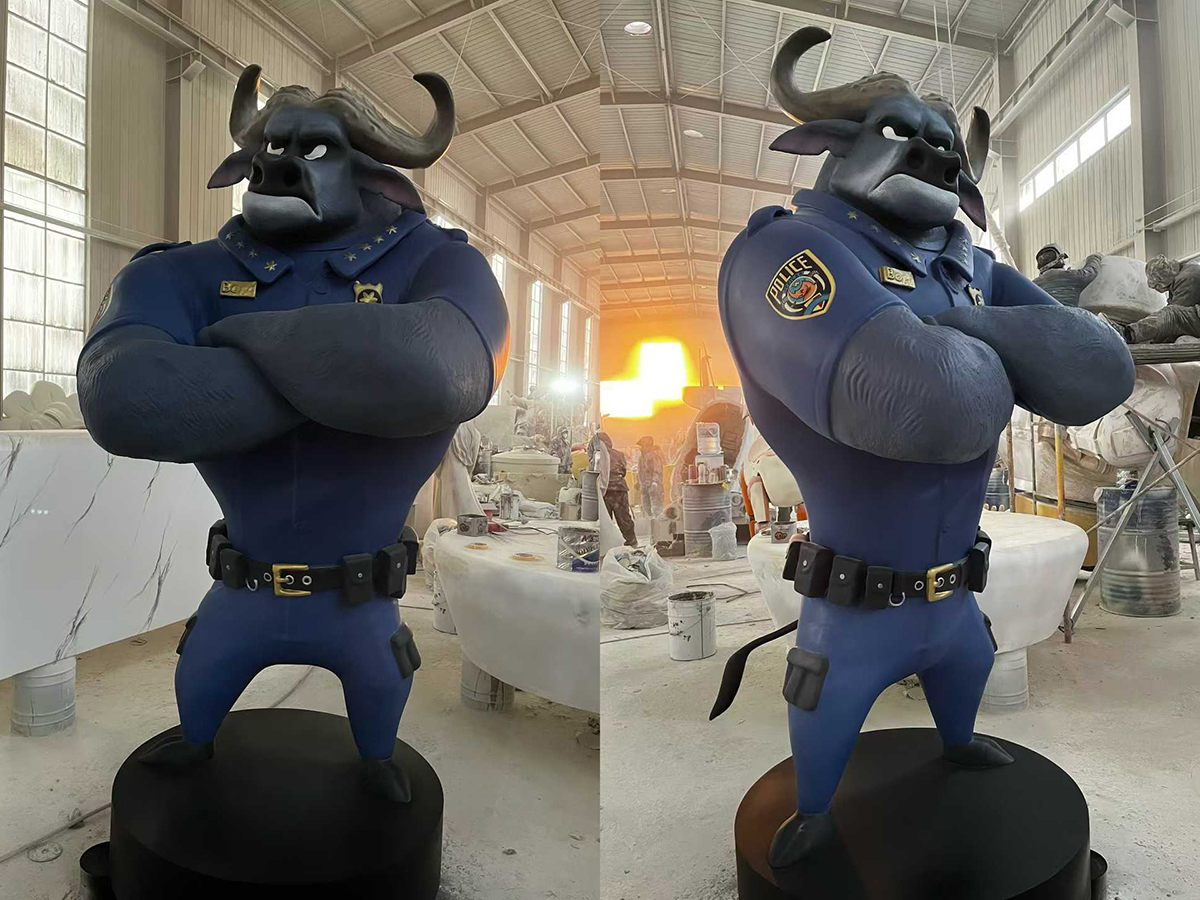
Every FRP sculpture requires a master prototype and a mold. The critical decision is how the prototype is produced. Everything downstream — cost, timeline, quality, and long-term reproduction — follows from that choice.
Path 1: Traditional Clay Sculpting
Process
- Steel armature: A welded skeleton (square tubing, angle iron) is built to the rough figure shape and rust-treated. Foam blocks and wire mesh are added to large pieces to reduce the clay load.
- Clay build-up and fine sculpting: Clay is applied in bulk to establish form, then refined by a master sculptor — facial features, skin texture, muscle definition, fabric folds, hair. The client reviews and requests adjustments at this stage; changes are made by adding or removing clay directly.
- Client sign-off: The clay model is confirmed before mold-making begins.
- Silicone rubber mold: Silicone (8–12 mm, applied in 4–6 brush coats) is built over the prototype, capturing fine surface detail. A rigid plaster or FRP backing shell (the “mother mold”) is applied over the silicone to prevent distortion.
- Demold: The shell is opened, clay removed, mold cleaned.
- FRP layup: The mold interior receives a gelcoat layer (pigmented resin), then 3–5 alternating layers of fiberglass cloth and resin to a wall thickness of 3–8 mm. Large pieces are built in sections.
- Cure, demold, and finish: The part cures for ~24 hours, is demolded, parting lines are ground down, defects filled with polyester body filler, and the surface is sanded. Final surface treatment (paint, patina, chrome effect, clear coat) is applied. Sections are bonded and mounting hardware fitted.
Strengths and Limitations
| No size constraint | 1:1 human figures (160–200 cm) are routine |
| Organic surface quality | Skin, fabric drape, and hair read as continuous — no layer artifacts |
| Real-time iteration | Client changes take hours, not days — the sculptor adjusts clay directly |
| FRP piece becomes durable master | The finished FRP part can serve as a re-molding master when the silicone mold wears out |
| Skilled labor dependency | Quality is tied directly to the sculptor’s ability |
| Longer prototype phase | A complex 1:1 figure may take 2–6 weeks of sculpting |
| Clay prototype is unique | Typically destroyed during mold-making; cannot be recreated without starting over |
Path 2: 3D Printing + Mold-Making
A 3D model is built in digital sculpting software (ZBrush, Blender, CAD), printed, post-processed, and used as the prototype for silicone mold-making. The FRP layup that follows is identical to Path 1.
Two technologies are relevant:
- FDM: Filament melted layer by layer. Affordable, but produces visible layer lines requiring heavy sanding — generally unsuitable for detailed figurative work.
- SLA/DLP: UV-cured resin at 25–100 micron resolution. Surface quality is dramatically better and far closer to hand-sculpted clay, making it the relevant technology for detailed work.
Where 3D Printing Works Well
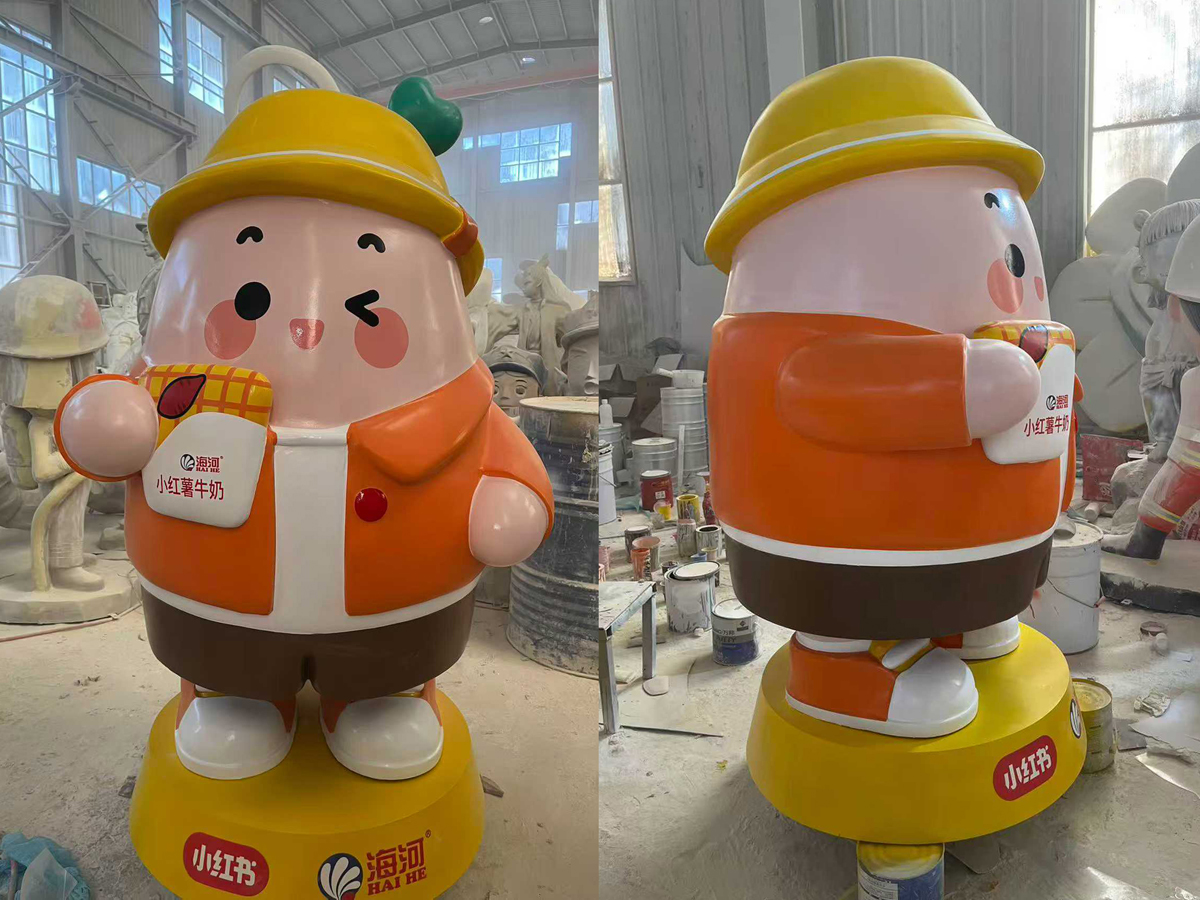
Geometric precision, perfect symmetry, cartoon or stylized IP characters, and cases where an approved digital asset already exists. Multiple identical prototypes can be printed without drift.
Why It Struggles with Complex Human Figures
Size and assembly: Even SLA printers max out at roughly 30 × 30 × 40 cm. A 1:1 human figure requires 30–60+ printed pieces, each joined, filled, and re-textured. On a geometric form this is manageable; on a human figure, joins across a cheek or through a clothing fold leave seam evidence that is extremely difficult to eliminate — and any flaw in the prototype transfers to every FRP copy.
Organic complexity: Fabric with natural gravity-driven drape, subtle facial asymmetries that convey character, and fine skin texture at life-scale are difficult to achieve algorithmically. Sculptors do this intuitively.
Iteration speed: Client revisions require reopening the file, modifying the mesh, reprinting affected sections, and rejoining — a cycle of days per round versus hours in clay.
Summary Comparison
| Factor | Clay Sculpting | FDM | SLA/DLP |
|---|---|---|---|
| Surface quality (organic forms) | Excellent | Poor | Good–Very Good |
| Max practical size | Unlimited | Assembly-limited | Assembly-limited |
| Client iteration speed | Fast (same day) | Slow (reprint cycle) | Slow (reprint cycle) |
| Geometric precision | Depends on sculptor | Excellent | Excellent |
| Complex human figures | Yes | No | Partial (size limit remains) |
| Cartoon / IP characters | Capable | Yes | Yes |
| Requires digital asset | No | Yes | Yes |
| Prototype is re-creatable | No (unique clay) | Yes (digital file) | Yes (digital file) |
Molds and Long-Term Reproduction
A silicone rubber mold yields approximately 15–25 pulls before surface detail degrades and release becomes unreliable.
When a mold wears out and more pieces are needed, a new mold must be made from a master prototype:
- Clay origin: The clay is typically destroyed during mold-making. The FRP finished piece becomes the only durable record of the sculpture and serves as the re-molding master going forward. This is why clients commissioning clay-based work should request both the finished FRP piece and the mold returned — the FRP part is a long-term production asset.
- 3D print origin: The digital file is the permanent master and never degrades. A new prototype can be reprinted at any time; there is no need to retain the physical piece for re-molding purposes.
How to Choose
By subject type
Lean toward clay sculpting if:
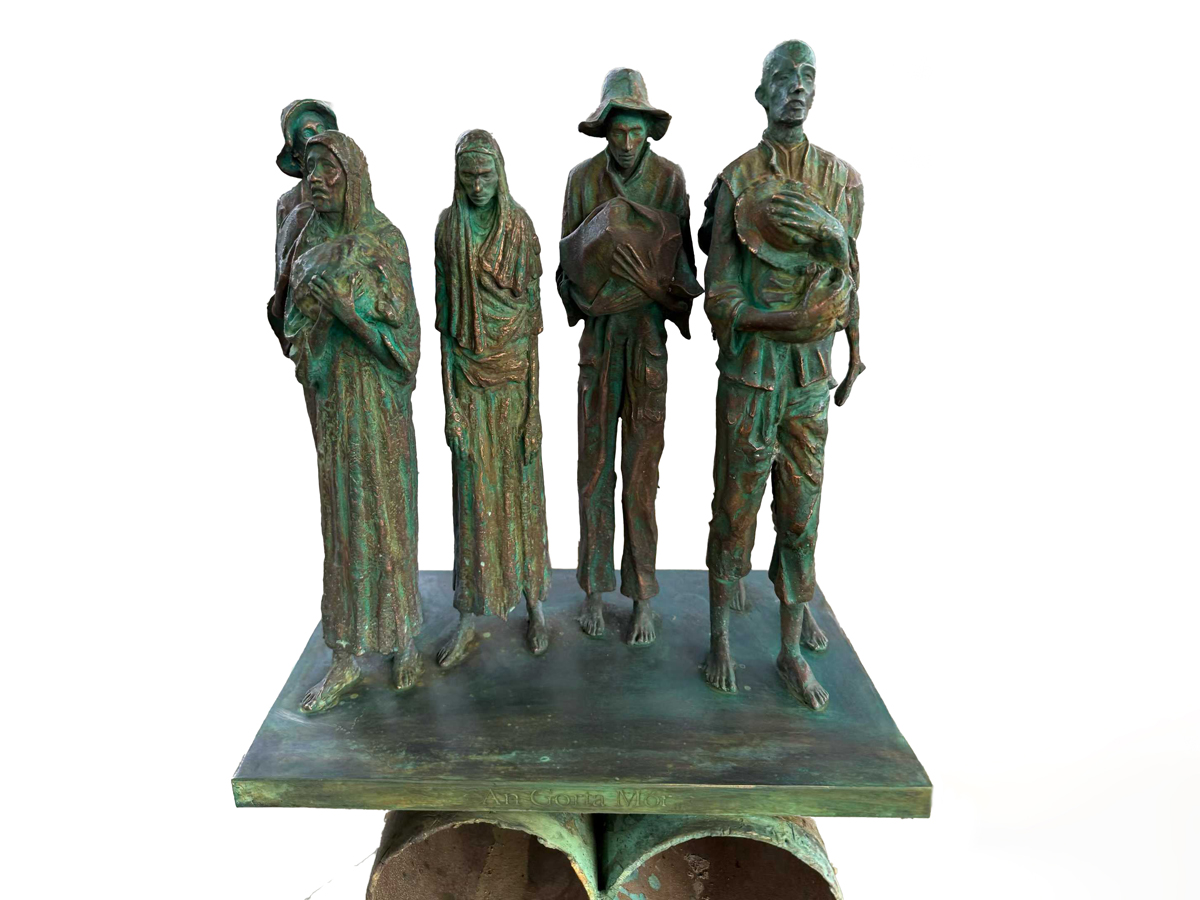
- The subject is a human figure, portrait, or character with realistic anatomy
- Scale is 1:1 or larger
- Fine organic texture (skin, fabric, hair) is important
- No approved digital asset exists
- Design iteration will happen through physical review
Lean toward 3D printing (SLA preferred) if:
- The subject is a cartoon character, stylized IP figure, or simplified animal form
- An approved 3D file already exists
- Geometric accuracy and symmetry are primary requirements
- Scale is under ~60 cm, or the design can accommodate visible assembly seams
By production volume
| Scenario | Recommendation |
|---|---|
| One-off, no future copies | Either process; optimize for quality |
| Limited run (5–20 pieces) | Clay; negotiate return of FRP master and mold |
| Ongoing production (20+ over time) | Clay or 3D if suitable; plan mold replacement; retain master |
| Digital IP replication | 3D print; retain digital file |
Questions to ask your manufacturer
- What is the prototype method — clay, FDM, SLA, or hybrid?
- Is there a dedicated master sculptor, or is it CAD-driven?
- What is the expected mold lifespan?
- Who retains the mold and prototype after delivery?
- What is the surface finishing process, and how does it affect outdoor durability?
- For multi-section sculptures: how are joins handled? Can you show finished examples?
Work with FacFox
FacFox handles the full FRP sculpture workflow in-house — master sculptor team for clay-based prototypes, SLA printing capability for digital assets, silicone mold production, FRP layup, and all surface finishing including paint, patina, and chrome effects.
Whether you need a single life-size installation or a batch of branded outdoor figures, we can advise on the right approach and provide a detailed quote based on your subject, scale, and production volume.
Get a quote → or contact us with your project brief, reference images, and target quantity.
Glossary
| Term | Definition |
|---|---|
| FRP | Fiber-Reinforced Plastic; composite of cured resin + glass fiber |
| Gelcoat | Pigmented resin applied first to the mold interior; forms the outer skin of the finished part |
| Silicone mold | Flexible rubber mold that captures fine surface detail; lifespan ~15–25 pulls |
| Mother mold | Rigid outer shell (plaster or FRP) supporting the silicone and preventing distortion |
| Layup | Laminating alternating layers of fiberglass cloth and resin inside the mold |
| FDM | Fused Deposition Modeling; filament-based 3D printing with visible layer lines |
| SLA/DLP | Resin-based 3D printing; fine layer resolution, superior surface vs. FDM |
| Re-molding master | The physical object used to make a new mold when the original wears out |