
A metal part is not necessarily finished when it leaves the printer.
Selective laser melting (SLM) can produce dense metal components with complex curves, internal passages, and consolidated geometries. However, the printed surface may still show a grainy texture, build-related marks, or variations between upward-facing, vertical, and recessed areas. Post-processing determines how much of that texture remains—and whether the final part looks matte, satin, or polished.
To make those differences visible, FacFox printed the same 3DP logo model multiple times and applied four finishing routes. We used both AL6061 aluminum and SS316L stainless steel as demonstration materials, but the central question in this comparison is not which metal is better. It is what each post-processing method does to an SLM surface.
- Sandblasting (default)
- Glass bead blasting
- Sandblasting followed by manual polishing
- Sandblasting followed by vibratory and magnetic polishing
Using one repeated model makes this more than a gallery of attractive metal parts. It creates a practical comparison of how the four processes behave on broad raised faces, outside walls, curved edges, and narrow recessed channels.
This article focuses on visible appearance and finishing access. The samples were not produced as standardized surface-roughness test coupons, so the photographs should not be interpreted as measured Ra values or performance certifications.
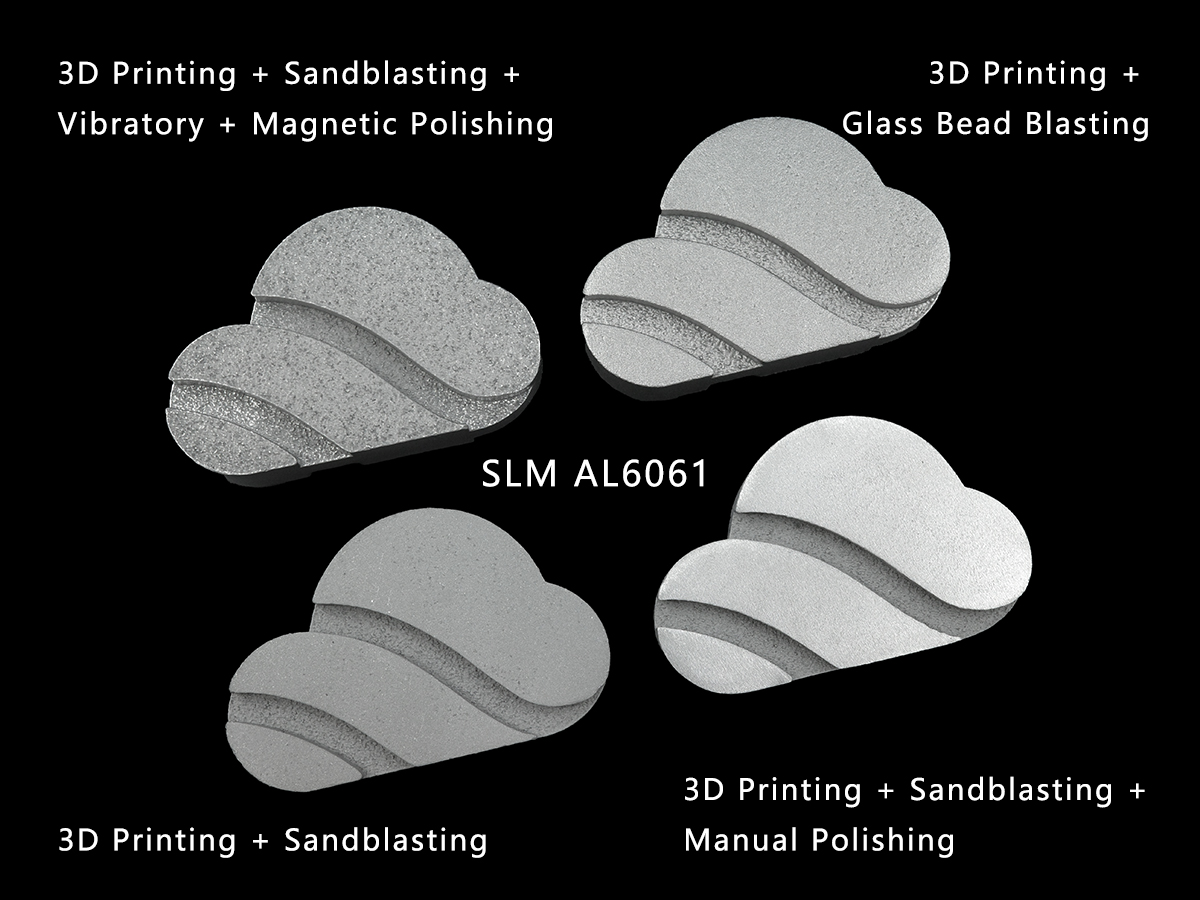
Why This Logo Is a Useful Finishing Test
The 3DP logo contains several surface conditions in one compact part:
- Large raised faces that are easy to inspect and relatively easy to reach with polishing tools
- Curved outlines that reveal how a finish transitions around an edge
- Vertical outside walls where build layers or finishing direction may remain visible
- Narrow recessed channels that are harder for tools and polishing media to reach
- Sharp transitions between raised and recessed areas where aggressive finishing could soften the geometry
That combination reveals an important rule: a finish name alone does not guarantee that every surface on a part will look identical.
The broad front faces of these samples respond strongly to polishing. The channels retain more of the original printed texture because they are less accessible. In a production component, internal passages, deep pockets, small holes, and protected corners can show an even greater difference.
1. Sandblasting: The Standard Matte Baseline
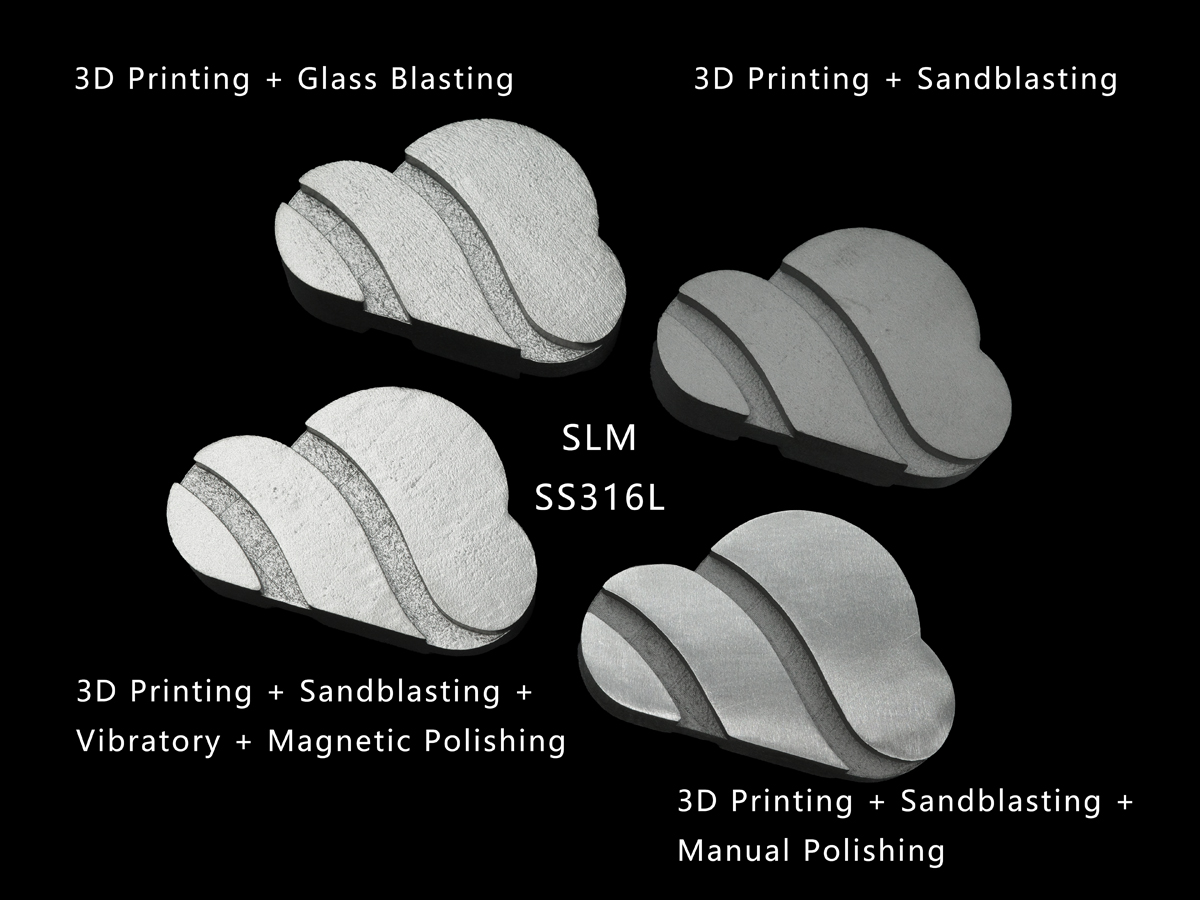
Sandblasting is the default surface treatment for the SLM AL6061 and SS316L samples in this project. A stream of abrasive media removes loose residue and creates a more consistent overall texture.
On both materials, the result is a low-reflection, industrial matte finish. It makes the raised faces look more uniform, but it does not erase every feature of the underlying printed surface. Texture remains especially visible inside the curved channels and along some sidewalls.
The two materials do not look exactly the same after the same finishing category:
- AL6061 appears light silver-gray with a soft matte surface.
- SS316L appears slightly darker and cooler under the same general type of lighting.
Sandblasting is a practical choice when the goal is a clean and consistent engineering finish rather than high gloss. It can also be a useful starting surface before another treatment, but the blasting medium, particle size, pressure, duration, and part orientation all influence the result.
Best suited for:
- General prototypes and functional parts
- Uniform matte appearance
- Parts without a high-gloss cosmetic requirement
- A cost-conscious standard finish
Important limitation: Sandblasting improves consistency but should not be treated as a precision smoothing process. If a sealing face, bearing seat, optical surface, or tightly toleranced interface needs a defined finish, machining or another controlled secondary process may still be required.
2. Glass Bead Blasting: A Brighter, Satin-Like Texture
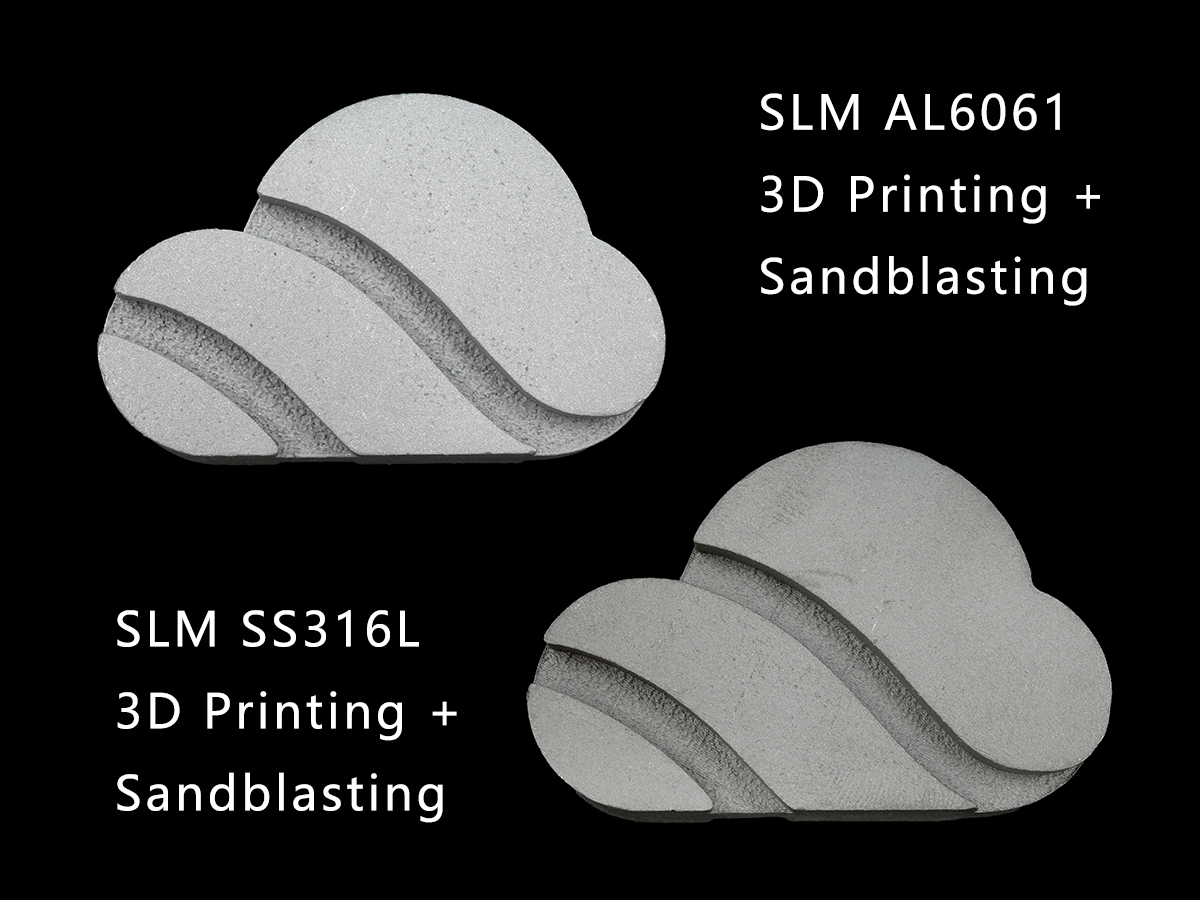
Glass bead blasting uses fine glass beads as the blasting medium. Compared with a more aggressively cutting abrasive, it is commonly selected to create a clean, satin-like appearance with a fine, evenly distributed texture.
On the 3DP samples, glass bead blasting catches light differently from the standard sandblasted finish. The broad faces appear brighter and more visibly textured. The effect is particularly noticeable on SS316L, where the surface has a lively metallic sparkle under direct light.
It would be misleading, however, to call every glass bead blasted surface “smoother” based on appearance alone. A bright surface can still have measurable roughness, and the final texture depends heavily on bead size and process parameters. For a cosmetic production part, a physical sample or approved finish coupon is more reliable than a finish name by itself.
Best suited for:
- Decorative matte or satin metal surfaces
- Parts that should look brighter than a conventional matte blast
- Cleaning and visually homogenizing accessible external surfaces
- Applications where directional polishing lines are undesirable
Important limitation: Glass bead blasting follows the existing geometry. Deep grooves and protected areas may respond differently from open faces, and blasting alone does not create a mirror finish.
3. Manual Polishing: The Brightest Accessible Faces
Manual polishing is a targeted process. An operator uses abrasive tools and polishing materials to progressively reduce surface peaks and improve reflectivity on selected areas.
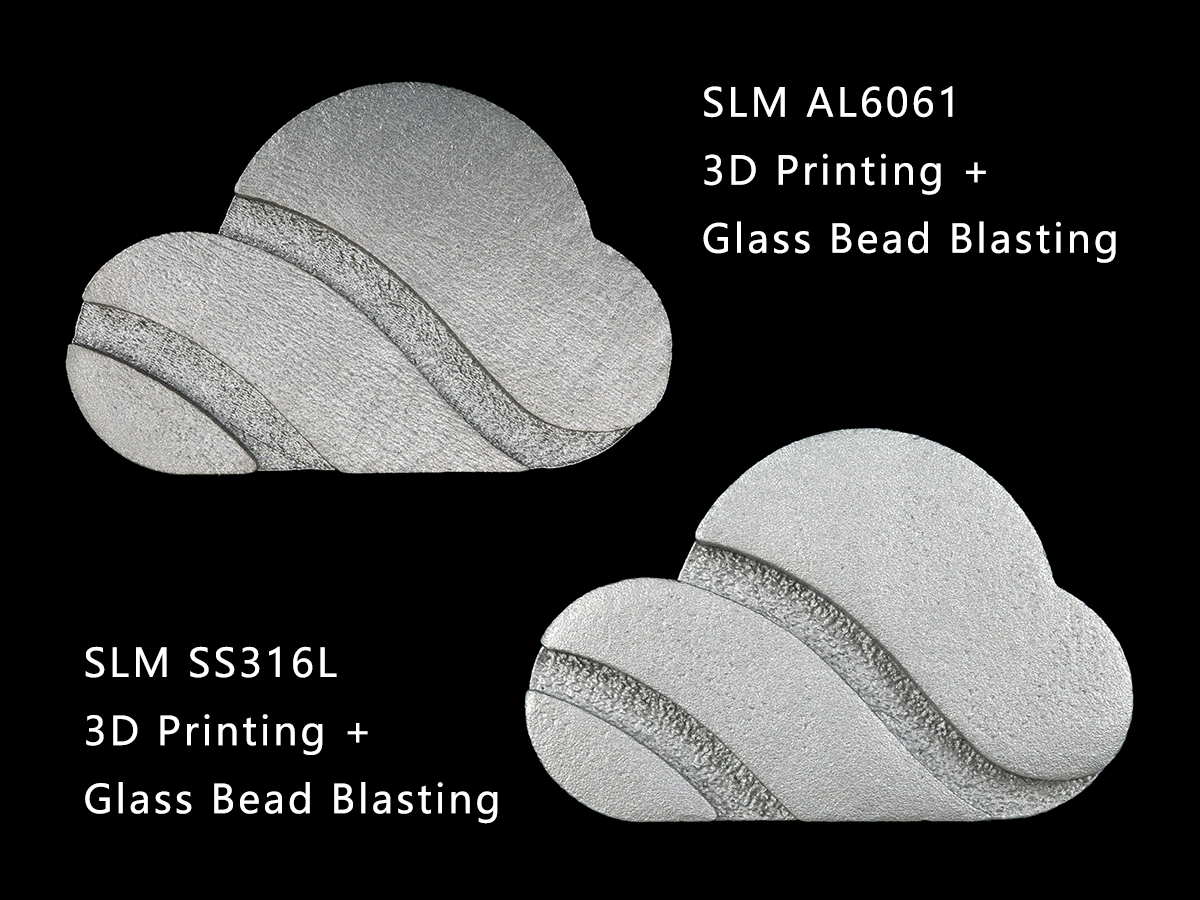
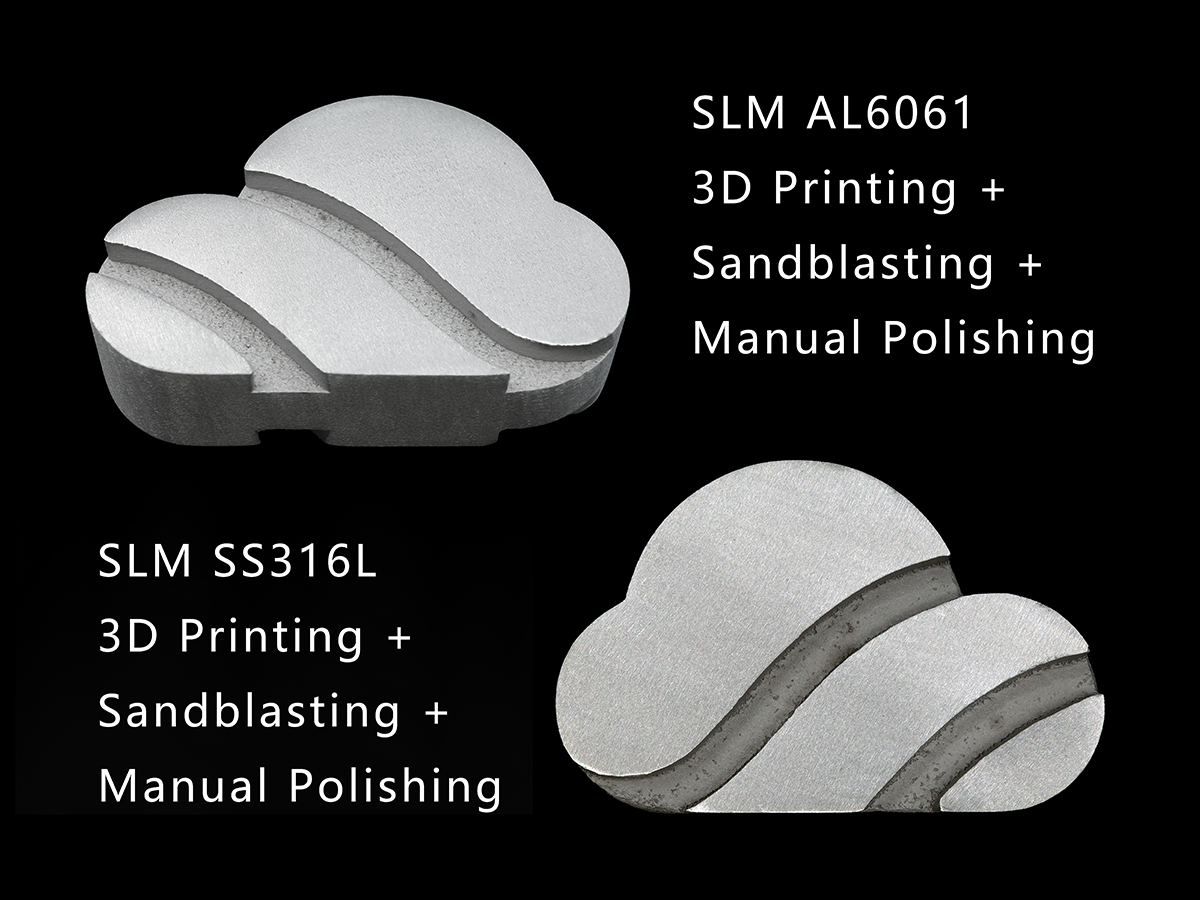
Among these samples, manual polishing produces the brightest broad faces. It also reveals a defining characteristic of the process: accessibility matters.
The raised logo surfaces are comparatively easy to polish, so they become visibly smoother and more reflective. The recessed channels are harder to reach and retain a coarser, darker texture. Light polishing lines may also be visible across the open faces, showing the direction in which the surface was worked.
This is not necessarily a defect. A controlled directional finish can be desirable on consumer products, display components, and visible housings. But if the specification simply says “polished,” the manufacturer still needs to know which surfaces are cosmetic and what level of gloss is expected.
Best suited for:
- Selected cosmetic faces
- Prototypes that need stronger visual impact
- Low-volume parts where operator attention is practical
- Areas that can be reached without damaging adjacent features
Important limitations:
- Deep channels, small holes, lattices, and internal passages may be inaccessible.
- Manual work can introduce directional variation.
- Material removal may soften sharp edges or affect dimensions if allowances are not planned.
- Complex parts usually cost more to polish because masking, handling, and inspection take longer.
4. Vibratory and Magnetic Polishing: Broader Batch Finishing
Vibratory and magnetic polishing are mass-finishing methods used to improve multiple exposed surfaces with less reliance on a hand tool following one face at a time. In this sample route, sandblasting is followed by vibratory and magnetic finishing.
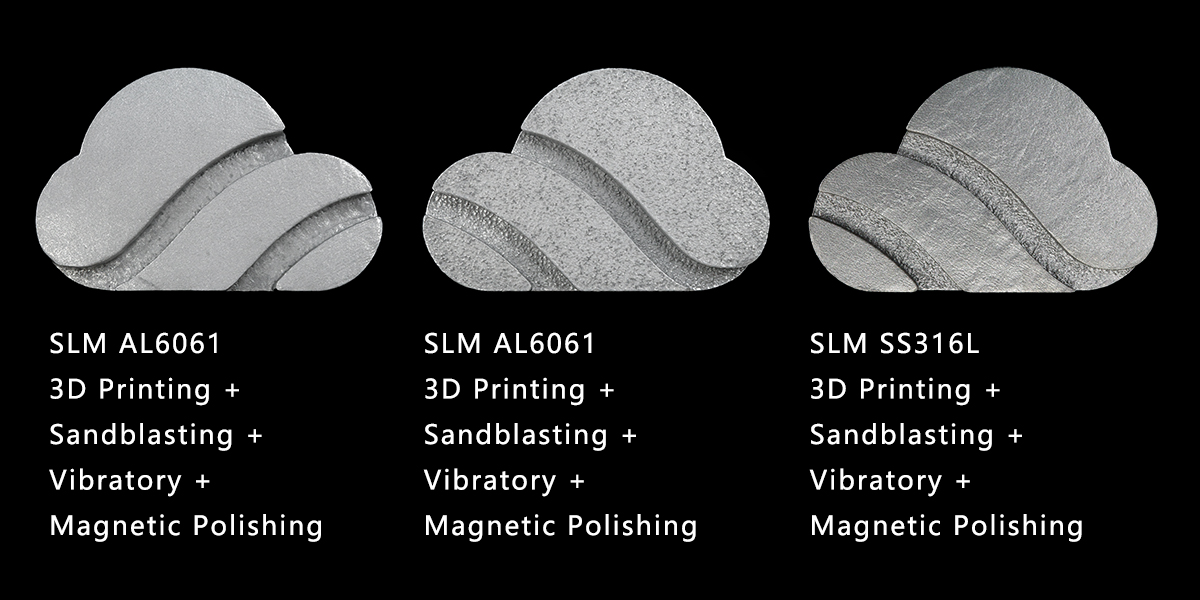
The process is useful for deburring, softening the feel of edges, and improving the consistency of accessible surfaces across a batch. The 3DP samples show a more evenly worked metallic appearance than the baseline sandblasted parts, but they do not become mirror-polished.
Small pits and local texture remain visible, particularly on AL6061. The recessed channels also stay rougher than the raised faces. This illustrates the difference between broad mass finishing and precision machining: media-based processes can improve overall surface condition, but they do not automatically correct every low point or protected feature.
Part geometry, media selection, cycle time, loading, and material all affect the outcome. Finishing media must be able to contact a surface and move effectively against it. Narrow gaps can limit access, while delicate edges may require a gentler process to avoid excessive rounding.
Best suited for:
- Batches of small or medium-sized components
- General deburring and edge softening
- Improving the feel and consistency of accessible surfaces
- Parts where a uniform production finish matters more than a hand-polished show surface
Important limitations:
- Recesses and internal features may finish differently from exposed faces.
- The process can round edges and alter very small features.
- A visually improved surface is not proof that a specified Ra has been achieved.
- Critical dimensions should be protected or verified after finishing.
What the Four Finishes Change—and What They Leave Behind
Each process produces a recognizable visual result, but none acts independently of part geometry. The broad raised faces show the greatest change, while the recessed channels retain more texture in every sample.
| Finish | Main visual change | What remains visible | Overall character |
|---|---|---|---|
| Sandblasting | Makes the general surface more uniform and reduces distracting variation | Graininess in channels and some sidewall texture | Industrial matte |
| Glass bead blasting | Produces a brighter, fine-textured surface that catches more light | Existing geometry and protected-area texture | Satin-like matte |
| Manual polishing | Creates the brightest and smoothest-looking accessible faces | Directional polishing lines and rougher recessed areas | Targeted cosmetic finish |
| Vibratory and magnetic polishing | Improves multiple exposed surfaces and softens the overall feel | Small pits, deep recesses, and geometry-dependent variation | Consistent batch finish |
The AL6061 and SS316L samples also demonstrate that a finish does not look identical on every metal. Base material affects color and light reflection, while print orientation, powder and machine parameters, support removal, finishing media, cycle settings, cleaning, and lighting can all influence the final appearance. These photos are therefore process demonstrations, not a material-selection ranking or a precise color standard.
The safest approach is to define the required result rather than relying only on a process label.
How to Choose the Right Finish
| Your priority | Recommended starting point | Why |
|---|---|---|
| Economical, uniform industrial matte | Sandblasting | A practical standard finish with low reflectivity |
| Brighter satin-like texture without directional lines | Glass bead blasting | Produces a fine, light-catching blasted appearance |
| Bright selected cosmetic faces | Manual polishing | Allows targeted attention on accessible surfaces |
| Batch deburring and more consistent exposed surfaces | Vibratory and magnetic polishing | Treats multiple external areas with less face-by-face manual work |
| Defined roughness or tight-tolerance functional face | CNC machining or controlled finishing with inspection | A named cosmetic finish alone does not guarantee a measured value |
For many real components, the best answer is not one finish applied everywhere. A part might use a blasted general surface, manual polishing on a visible face, and CNC machining on a sealing or mating interface.
Final Takeaway
Post-processing does not simply make an SLM part “better.” Each of the four options changes the part in a different way.
Sandblasting provides a practical matte baseline. Glass bead blasting creates a brighter satin-like texture. Manual polishing produces the most reflective accessible faces, but its result is selective and directional. Vibratory and magnetic polishing can improve batches of exposed surfaces, while geometry still controls which areas the finishing media can reach.
The 3DP logo samples make one lesson especially clear: broad faces, sidewalls, edges, and recessed channels can respond differently even on the same part. Choosing among the four options should therefore start with geometry, production volume, cosmetic expectations, and functional tolerances. Material selection is a separate engineering decision and will be covered in a dedicated comparison.
If you are planning an AL6061 or SS316L SLM project, upload your CAD model and mark the critical surfaces. FacFox can review the geometry and recommend a practical combination of printing, blasting, polishing, machining, and inspection for your application.